How to Price Your Digital Downloads for Maximum Sales
Learn how to price digital downloads in rand, with practical South African examples, competitor research, pricing psychology, bundles and simple tests to find a price that works.
15 min read

On this page
Pricing Digital Downloads in South Africa: A Practical Guide
Pricing digital downloads works best when you find the point where three things meet: the value your buyer gets, what similar products charge, and what you need to earn to keep creating. Start with the outcome you deliver rather than the hours you spent, then test and adjust using your own sales data. Below, I'll walk through how to work out what your ebook, template or printable is worth in rand, which pricing psychology holds up, and how to test your way to a number you feel good about. 🙌
Why Underpricing Digital Downloads Hurts More Than You Think 💸
Picture a Durban creator who launches a Canva template pack at R39. A few sales trickle in, and two buyers ask for refunds. She raises the price to R249 and rewrites the product page to explain what the pack saves a small business owner. (This is an illustrative composite, not a promise that a price rise will boost sales. A new price only works if the page makes the value clear.) The product didn't change. The signal did.
Price is a trust shortcut. Buyers can't touch a digital file before they buy it, so they lean on clues. A 1989 review by Rao and Monroe found a positive relationship between price and perceived quality, though how strong it is depends on things like brand and product category. Price alone doesn't prove quality, but a very low price can undercut the quality signals you've worked hard to build.
The maths of pricing digital products cheaply
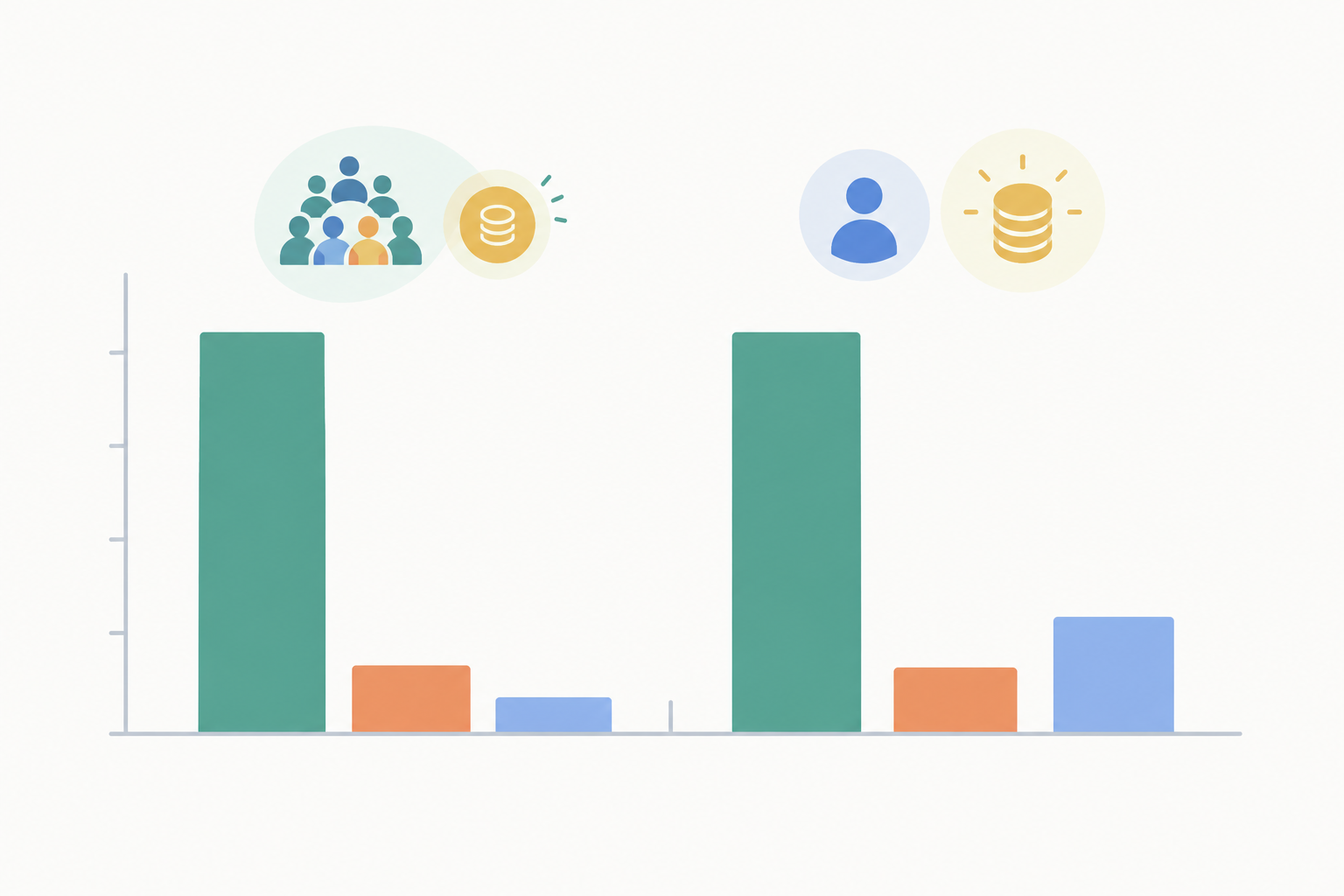
Let's compare two routes to the same revenue:
- 100 sales at R50 = R5,000
- 25 sales at R200 = R5,000
Same money, but the first route means four times the customers to support and four times the emails. Fixed per-sale fees also bite harder at low prices. At the time of writing, Gumroad lists 10% plus 50 US cents on direct sales (see its current pricing page). On a $5 item that's about 20% gone before anything else, and on a $20 item about 12.5%. A purely percentage-based fee takes the same share at any price: on Shopstar's Start Free plan, for example, you pay 6% all-in per sale, which is R3 on an R50 download and R12 on an R200 one. Rates depend on the channel, your country and your payment method, and they change, so check your own platform before doing the sums.
Then there's the volume hurdle. Cut a price by 50% and you need to sell 100% more units just to stand still on revenue, and more once fees and support are counted. McKinsey's analysis of 1,200 companies (often cited from its pricing research) found a 1% price increase lifted operating profit by 8.7% on average, assuming volume didn't drop. That's a big-business benchmark, not a forecast for your store, but it shows how much a small price move can do.
Very low prices can also leave little for marketing, updates or your own time, which is how creators burn out on products that technically sell. Some sellers report more refund requests or support queries at the bottom end of the market. I wouldn't treat that as a rule, so watch your own refund rate rather than assuming.
How Do You Know What Your Digital Product Is Worth?
Nobody hands you a correct number, but you can get close in five steps.
- Define the outcome. What problem does your download solve? How much time or money does it save? 'A 40-page budgeting ebook' is a description. 'A system that helps freelancers set aside money for provisional tax every month' is an outcome, and outcomes are what people pay for.
- Anchor to value, not effort. Compare your price to what it costs the buyer to do it themselves or hire a professional. A spreadsheet that saves a business owner hours of recurring work can justify more than a generic template, as long as the benefit is clear and believable. Cost sets your minimum, while perceived value helps set the ceiling.
- Work out your floor price. Add up platform and payment fees, any tax you owe, the time you spend on support and updates, and the profit you want. VAT in South Africa is 15%, but registration only becomes compulsory once your taxable supplies pass R2.3 million in 12 months (up from R1 million since 1 April 2026). If you are registered, VAT is part of the price your buyer pays, so build it in. Check SARS's VAT guidance or ask an accountant.
- Consider your audience and trust level. A new creator with no reviews and an established expert with 20,000 followers can price differently. That's just how trust works. Newer sellers can close some of the gap with previews, testimonials and a clear guarantee.
- Pick a starting price and treat it as a hypothesis. It's a test, not a verdict.
How to Research Prices for Similar Digital Downloads
Competitor research isn't about copying the lowest price. It's about knowing the range buyers are used to seeing, so you can place yourself on purpose.
Where to compare digital product prices
- Etsy and Gumroad listings
- Other creator marketplaces
- Other South African creators' link in bio pages and online stores
- Bestseller or featured sections in your niche
Compare like with like. A single-page printable isn't a benchmark for a large editable planner bundle, and a personal-use template isn't the same as one with commercial rights. Also check whether a price is a one-off purchase, a subscription or a tiered offer. Otherwise a competitor can look cheaper or dearer than they really are.
Build a simple competitor research sheet
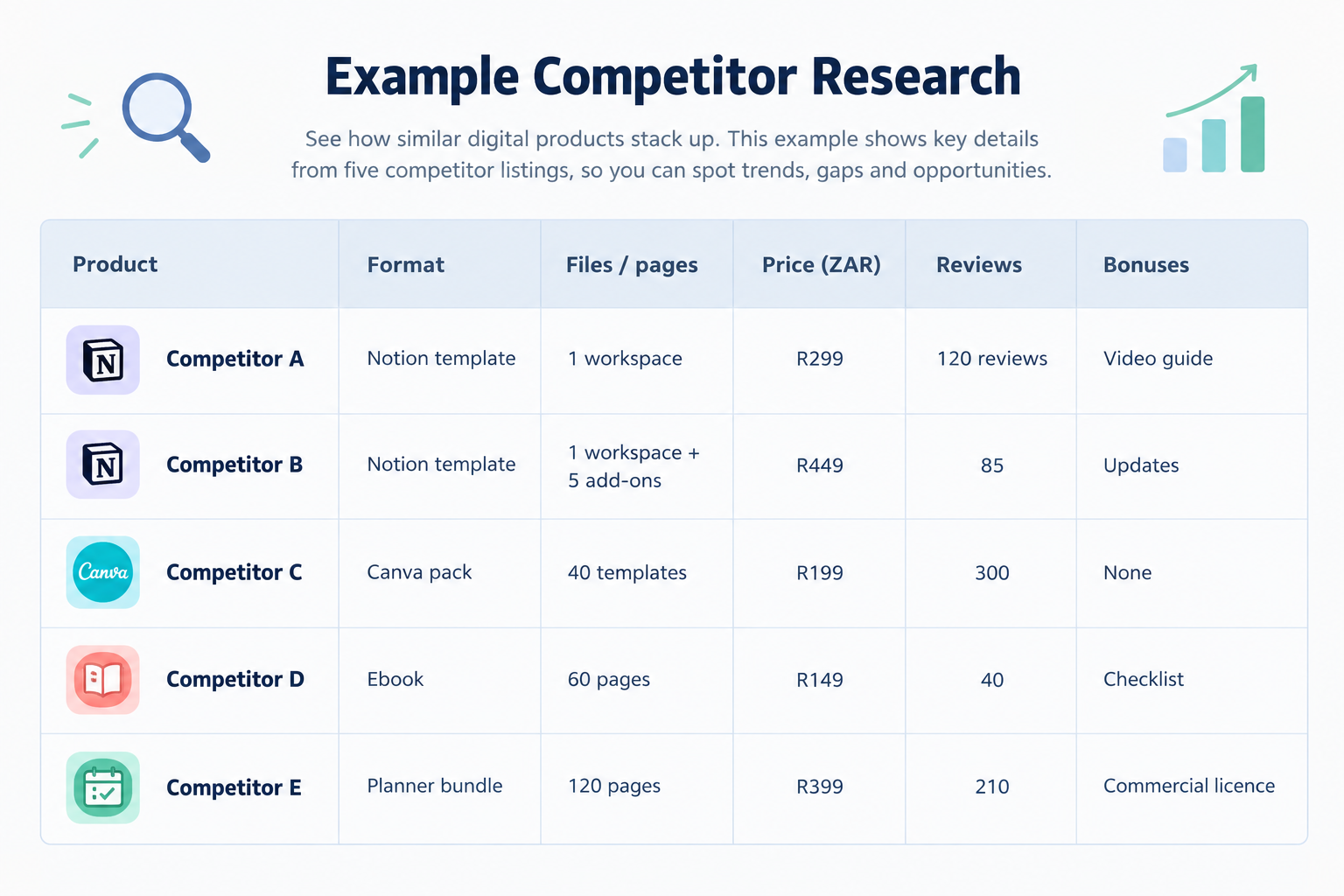
Open a spreadsheet and log five comparable products:
| Product | Format | Files / pages | Price | Reviews | Bonuses |
|---|---|---|---|---|---|
| Competitor A | Notion template | 1 workspace | R299 | 120 | Video guide |
| Competitor B | Notion template | 1 workspace + 5 add-ons | R449 | 85 | Updates |
| Competitor C | Canva pack | 40 templates | R199 | 300 | None |
| Competitor D | Ebook | 60 pages | R149 | 40 | Checklist |
| Competitor E | Planner bundle | 120 pages | R399 | 210 | Commercial licence |
The figures above are fictional, just to show the layout.
Find your own price range
I'm deliberately not handing you a list of 'typical' South African prices for ebooks or templates, because they go stale quickly and vary by niche. Build your own from live listings instead. Note the lowest price, the middle one and the highest. In the fictional sheet above that's R149, R299 and R449. Then ask what separates the cheap listings from the dear ones. Is it more files, bonuses, licences, reviews or support?
Choose your pricing position
- Budget: lowest in the range. You need volume and very low support demands.
- Mid-range: around the middle. You need clear benefits and decent reviews.
- Premium: top of the range or above. You need polished presentation, proof of results and extras like support or updates.
In a crowded market, differentiate with a narrower audience, better bonuses or stronger proof rather than racing to the bottom. In a niche with no comparisons, look at adjacent products and at what the buyer's alternative costs, then start a little higher than feels comfortable.
One more thing: channel costs matter. Etsy charges listing and transaction fees (see its current fee page), and Gumroad's rate depends on whether the sale came through your own link or its Discover marketplace (30% at the time of writing). Fees also vary with your location and payment method, and on an international platform you may be pricing in dollars and converting back to rand, so the same price can net you very different amounts depending on where the sale happens.
Pricing Psychology That Actually Works for Digital Downloads 🧠
Psychology can nudge a decision, but none of it is magic. Treat each of these as something to test, not a rule.
- Charm pricing (R199 vs R200). Shoppers weigh the leftmost digit heavily, so R199 can feel closer to R100 than R200. Anderson and Simester's field experiments on $9 price endings (2003) found one such price lifted demand by 24%, though that was a specific retail test. Round numbers can feel more premium, so for high-end or design-led products, R200 or R1,500 may suit you better. Test R199 against R195 or R200 with everything else unchanged.
- Price anchoring. Show a higher-priced bundle or the 'full value' next to your main offer, and the main offer can seem more reasonable. The anchor has to be genuine and useful. A made-up comparison damages trust.
- The decoy effect. A third option can steer people between the other two. In Dan Ariely's well-known classroom exercise (described in his book Predictably Irrational), 84 of 100 students chose a $125 print-plus-online bundle when a print-only option at the same price was shown, versus 32 of 100 when it was removed. It's a small, hypothetical illustration, not a sales forecast, but it shows why a good-better-best menu deserves careful design.
- Simple price displays. Skip the clutter, the strikethrough chaos and the confusing currencies. One clear price in rand, with VAT already included if you're registered, usually does the job.
- Pay-what-you-want. Platforms like Gumroad let you set a minimum and let buyers pay more. It can suit a sample, a community resource or an audience keen to support you, but it isn't evidence that people will routinely pay above the minimum. Make sure the minimum alone is worth your while.
On choice overload, a 2010 meta-analysis of 50 experiments by Scheibehenne, Greifeneder and Todd found the average effect was close to zero. So don't assume three tiers always beat four. Make the differences easy to scan, then test.
Using Tiered Pricing and Bundles for Digital Products
Is bundling better than selling separately? It can be. Bundles may raise average order value, while single items help new buyers get started. Whether that happens for you depends on your audience, your offer and how clearly the bundle is presented, so treat it as a hypothesis to test. A sensible starting point is to offer both: a low-risk entry product, and a bundle for people ready to go deeper.
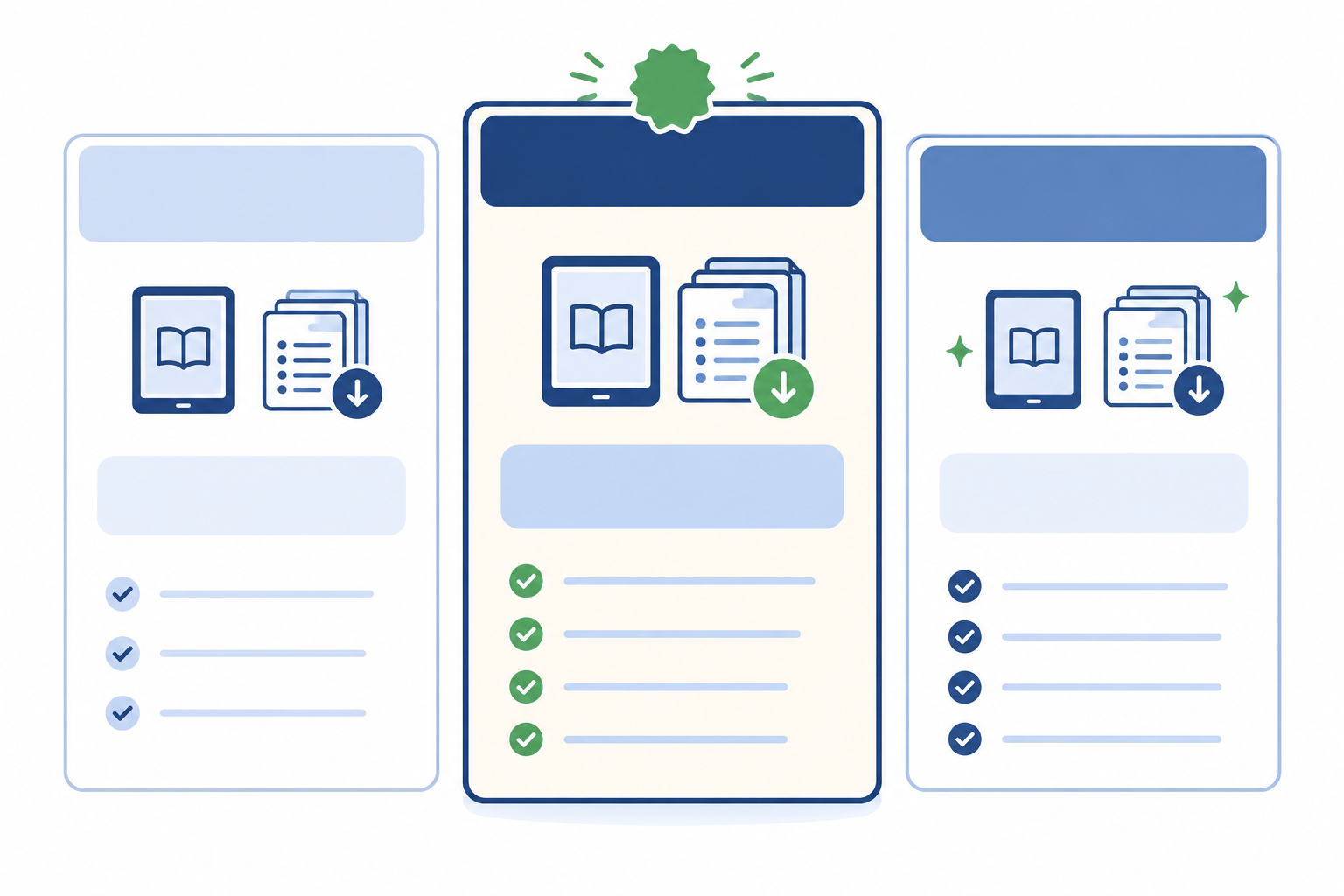
An example digital product pricing structure
| Tier | What's included | Example price |
|---|---|---|
| Basic | The main file (ebook or template) | R149 |
| Plus | File + bonus templates | R299 |
| Pro | Everything + walkthrough or support | R599 |
Those prices are examples only. You could label the tier that fits the most common need as 'Recommended', as long as it's a genuinely better deal. Save 'most popular' for when your order data shows it's true.
Make your digital download bundle feel coherent
A bundle should solve one bigger problem, not be a random pile of files. 'Everything you need to launch a freelance business' works. 'Eleven things I had lying around' doesn't. Price it so the saving is obvious, say 20-30% below buying separately, but not so deep that your individual products start to look overpriced.
Add order bumps and upsells
At checkout, a small add-on, such as an extra template set or a quick-start video, can lift order value with almost no extra work. It works best when buyers can add it without starting another purchase. An online store builder that supports add-ons and a single checkout makes this much easier, so setting up tiers doesn't mean building a full website.
Should You Offer a Free Sample or Preview of Your Digital Product?
Usually, yes. People can't touch a digital product, so a preview lowers their risk. A sample chapter, a few free template pages, clear screenshots or a short video walkthrough all work well.
It helps to separate two things. A preview shows a slice of the exact product so buyers know what they're getting. A lead magnet is a free, standalone resource that earns an email address and builds trust, and you can follow it with an offer for the paid product. Use previews on the product page, and lead magnets to attract people who aren't ready yet.
To avoid giving away all the value, share the problem and a taste of the method, not the finished result. Show three templates out of thirty, or one chapter that gets someone a quick win.
On a link in bio page, put the free item first or second, with the paid product right beneath it. Someone who grabs the freebie then sees the natural next step without hunting for it.
How to Test and Adjust Your Digital Download Prices
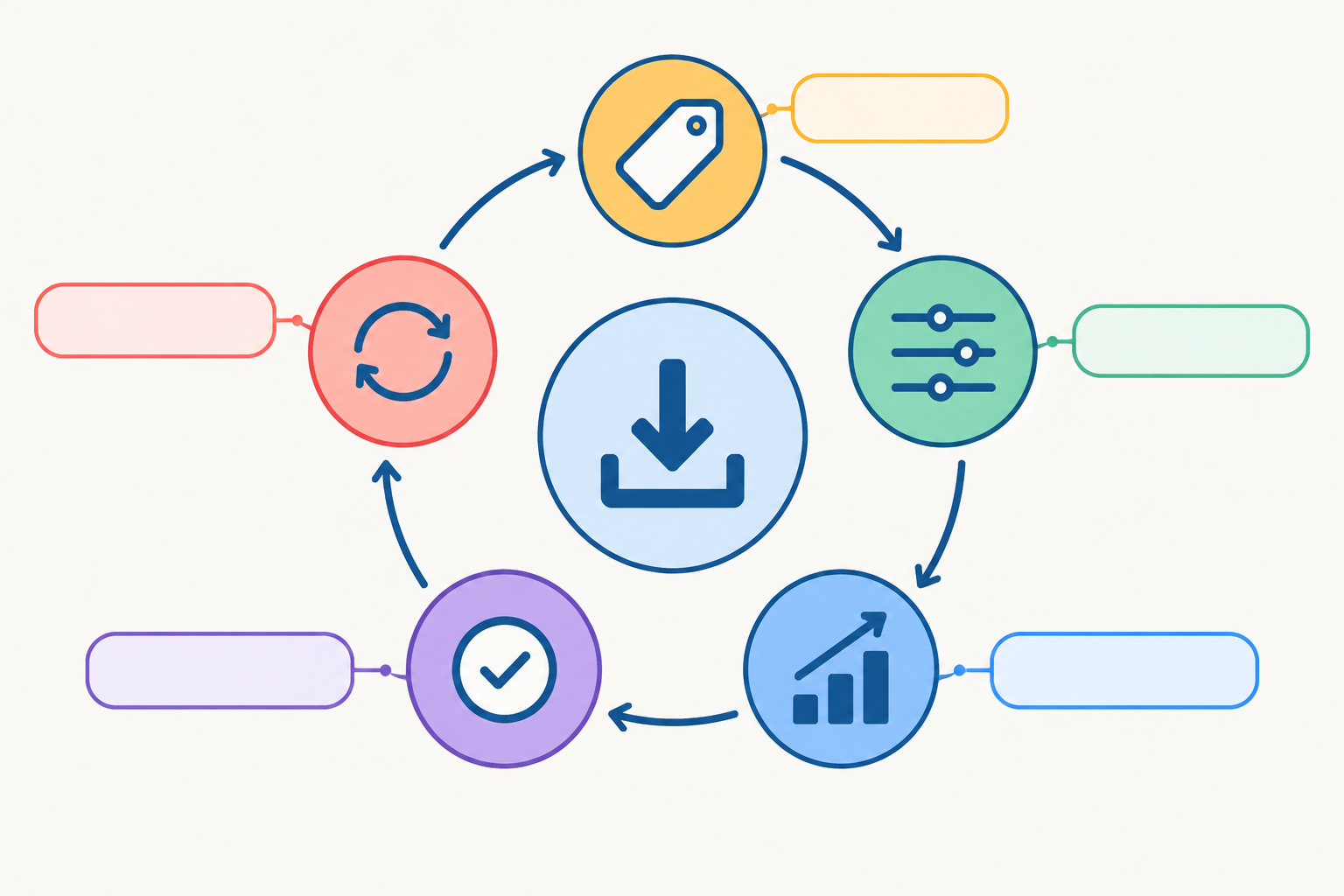
Your starting price is a hypothesis. Here's how to test it without a data science degree.
- Set a baseline. Record views, conversion rate and revenue for at least a few weeks before changing anything.
- Change one thing at a time. The price, the bundle or the page copy, not all three, or you won't know what worked.
- Run a time-based test. Try price A for a few weeks, then price B, or launch pricing followed by a planned rise. Compare similar periods where you can: many South Africans are paid around the 25th, so a payday week and a quiet mid-month week aren't a fair match. Don't compare different traffic sources against each other, because audiences differ in intent and any difference in sales may have nothing to do with price.
- Watch the right metrics: conversion rate, average order value, refund rate and revenue per visitor. A higher price can reduce sales and still improve profit per visitor.
- Review on a schedule. A light check monthly, and a proper price review each quarter or after a major update.
- Know the signs it's time to raise your price: steady sales, glowing reviews and few price objections.
- Use your order data. Dashboards, including AI-powered tools for managing orders, products and customer data, can help you spot patterns like which bundles sell best.
A caution for small stores: if you only get a few dozen visitors a month, a test may not give you enough data for a confident answer. Payday, the December festive season, a long weekend like Heritage Day or a social post going well can swamp the effect of a price change. Note what else was going on during each test period, and treat small-sample results as hints rather than proof. Longer tests and bigger changes tell you more than tiny tweaks.
Some handy break-even maths: after a 10% price rise, you can lose about 9.1% of your sales before revenue falls. After a 10% price cut, you need about 11.1% more sales to match old revenue. That's revenue only, so factor in fees, refunds and support when you're thinking about profit.
Keep a simple log of test dates, price, context, sales and refunds. Otherwise in three months you'll have no idea what you tested. And re-check when your product, audience or competitors change.
When to Offer Discounts on Digital Downloads (and When Not To) 🏷️
Discounts are a tool, not a lifestyle.
Good reasons to discount:
- A launch offer to build early sales and reviews
- Seasonal moments like Black Friday, the December festive season or back-to-school planning in January
- Bundles that reward bigger purchases
- Loyalty rewards for existing customers
Bad reasons:
- Panic after one slow week
- Guilt about your price
- Training your audience to always wait for a sale
How deep should you go? Modest, time-limited offers with a clear explanation tend to work better than permanent mega-sales. Many creators stay around 10-30%, but your fees and margins decide what's sustainable. Before discounting, calculate what you keep per sale after payment fees, platform fees, tax and support.
Be honest about the 'was' price. South Africa's Consumer Protection Act expects businesses to give clear, accurate information and gives buyers recourse against misleading claims, so a reference price should be one you genuinely charged. Check how the rules apply to your situation (the national consumer regulator has an overview of the Act) before advertising a markdown, and never inflate a list price just to show a discount.
Try alternatives first. Add a bonus file, extend support or upgrade the bundle. That protects your core price while still giving price-sensitive buyers a reason to act.
And track it. Use a discount code for each promotion, compare revenue per visitor with a period without a discount, and check whether you made new sales or just discounted people who would have paid full price. Also remember that unexpected costs put people off at checkout. The Baymard Institute's cart abandonment research found that, leaving aside people who were just browsing, 40% of surveyed US shoppers who abandoned an order cited extra costs as too high, so make your final price clear up front. A discount won't fix that.
A Simple Digital Download Pricing Plan You Can Use This Week
You don't need a perfect number. You need a plan. Here's how it might look for an imaginary product, a budgeting spreadsheet that helps freelancers put money aside for provisional tax:
- Calculate your floor price and note your value-based price. Say fees, tax and support mean you need at least R120 per sale, while the stress it saves a freelancer at provisional tax time feels worth R350 or more.
- Fill in a quick competitor sheet with five comparable products. Suppose they range from R149 to R449, with a middle around R299.
- Choose a positioning and a starting price. Mid-range with a clear outcome and a preview suggests R299.
- Add one bundle or tier option so buyers have a choice, such as the spreadsheet plus a provisional tax calendar and a short walkthrough video.
- Publish, track, and book your first price review in your calendar for about a month out (ideally a full 25th-to-25th pay cycle), then a bigger one at the quarter. If sales are steady and refunds are low, try a modest rise and compare similar periods.
So pick a number, publish, and watch what happens. Starting and adjusting beats waiting for the perfect price every time. 💛
A quick note on tools. We build Shopstar, a South African ecommerce and link in bio platform that lets you sell digital downloads alongside memberships, bookings or event tickets from one page. Payments are built in with Shopstar Go: buyers pay by card, Apple Pay (on compatible devices) or Scan to Pay, the file goes out the moment they pay, and payouts land in your South African bank account daily. You can start free with no monthly fee and 6% all-in per sale, or move to the Lower Fees plan, with a monthly fee and 2.9% per sale. Our team is happy to help with onboarding.
Sources and Further Reading
Figures and studies mentioned above, so you can check the wording yourself:
- Rao, A. and Monroe, K. (1989), review of price, brand name and store name effects on perceived quality, Journal of Marketing Research
- Anderson, E. and Simester, D. (2003), 'Effects of $9 Price Endings on Retail Sales: Evidence from Field Experiments', Quantitative Marketing and Economics
- Ariely, D. (2008), Predictably Irrational
- Scheibehenne, B., Greifeneder, R. and Todd, P. (2010), choice overload meta-analysis, Journal of Consumer Research
- McKinsey & Company pricing research (the 8.7% operating profit figure)
- Gumroad pricing, Etsy fees, Baymard cart abandonment research
- SARS VAT guidance, the SARS Budget 2026 FAQs on the new VAT thresholds, SARS on provisional tax and the national consumer regulator's overview of the Consumer Protection Act, for South African rules
Fees and rules change, so always check the current version at the source.
FAQ: Pricing Digital Downloads
How often should I change my prices?
Check your numbers monthly, but only change prices deliberately, roughly every quarter or when you've meaningfully improved the product. Constant tweaks make it hard to learn what works and can confuse repeat customers.
Should I price in rand if I sell internationally?
If most of your buyers are in South Africa, show prices in rand so they don't have to think about conversion. If your audience is global, pick a clear primary currency and check how your platform and payment processing handle currency differences and fees.
Do I need to charge VAT on digital downloads in South Africa?
Only if you're registered for VAT. From 1 April 2026, registration is compulsory once your taxable supplies pass R2.3 million in 12 months, and you can register voluntarily from R120,000. If you are registered, VAT is 15%, so build it into the price buyers see. Separately, your profit is taxable income, and freelancers and sole proprietors may need to pay provisional tax. Check current guidance from SARS or speak to an accountant before launching, since the rules can change.
Is it okay to start low and raise the price later?
Yes, if you frame it as an introductory or launch price and tell people it's going up. Avoid starting so low that raising it feels like a shock, and let early buyers know they got a good deal.
What if people say my digital download is too expensive?
Look at whether they understand the outcome before you cut the price. Improve the product page with clearer benefits, previews and reviews first. If price objections stay high after that, test a lower tier rather than reducing the whole range.