How to Write Product Descriptions That Actually Sell: A Plain-Language Guide for South African Sellers
Learn how to write product descriptions that sell with a simple 4-part formula, practical before-and-after examples and plain-language copywriting tips.
13 min read
On this page
A product description that sells talks about the buyer first and the product second. It answers the questions a customer would ask you in person: what is it, is it right for me, what will it do for me, and what happens after I pay? That's really all there is to it. A simple 4-part formula (hook, benefits, specifics, next step) works for physical products, digital downloads, bookings and event tickets, and you don't need to be a writer to use it.
In this guide, I'll show you how to write product descriptions in plain language. You'll get before-and-after rewrites priced in rand, plus a short rundown of the South African legal basics worth knowing. 🙌
A note on the examples: every product, price and specification in this post (the candle, the tea, the phone sleeve) is made up to illustrate the method. When you write your own, swap in details you've tested and can prove.
Why your product description has to do the selling when you're not there
Picture this. It's 9pm, load shedding has just kicked in, and someone taps your link in bio. They can't pick up your candle, smell it, or hear you explain how it burns. All they have is your photos and your words.
If a customer WhatsApped you, you'd answer in seconds: 'Yes, it's 200g, it burns for about 40 hours, and I can courier it to Durban by Thursday.' On a product page, the description is that conversation, written down once. If it's vague, the questions don't disappear. They turn into abandoned carts and a flood of 'is this still available?' DMs.
The research points the same way. Salsify's 2024 Consumer Research report found that 87% of the shoppers it surveyed said product content was extremely or very important to their buying decision. It's a global study, not a South African one, so treat it as a pointer. It does match what most sellers see in their inboxes.
The good news is that this guide is for non-writers. You don't need fancy vocabulary, just clarity and a little structure. And if you sell through a single page like Shopstar, where each product, booking or ticket gets its own description, it pays to get each one right once and let it keep working for you.
Start writing product descriptions with the buyer, not the product
Here's the trap we all fall into: we describe what we made ('100% soy wax, 200g') instead of why someone would want it. Nielsen Norman Group's research on e-commerce product pages keeps coming back to the same idea. Work out who the buyer is and what decision they're trying to make, then show how your product fits, before you list materials and dimensions.
Five questions to answer before you write a product description
- Who is this for? (A gift buyer? Someone treating themselves? A parent in a hurry?)
- What problem does it solve, or what feeling does it give?
- When or where will they use it? (A load-shedding evening, a braai weekend, a school-lunchbox morning, a Joburg winter.)
- What would make them hesitate? (Size? Delivery time? Whether it'll arrive in one piece?)
- What would they ask me on WhatsApp?
Question five is gold. Scroll through your DMs, comments and old customer messages, and borrow the exact words people use. That's the language your buyers think and search in, so it'll sound natural on the page.
A two-minute exercise to find your product description hook
Finish this sentence three different ways: 'People buy this because...'
For a candle you might get 'it smells nice' (weak), 'it gives the lounge a cosy glow during load shedding' (better), and 'it gives a long, even burn so one candle can last you a few evenings a week through winter' (specific and useful, as long as your own testing backs it up). Keep the most specific one. That's your hook, sorted.
A quick note on privacy: if you want to quote a customer's review by name or share their photo, ask permission first. The Protection of Personal Information Act (POPIA) covers people's personal information, and a polite 'Can I feature your message?' goes a long way.
How to write product descriptions with a simple 4-part formula
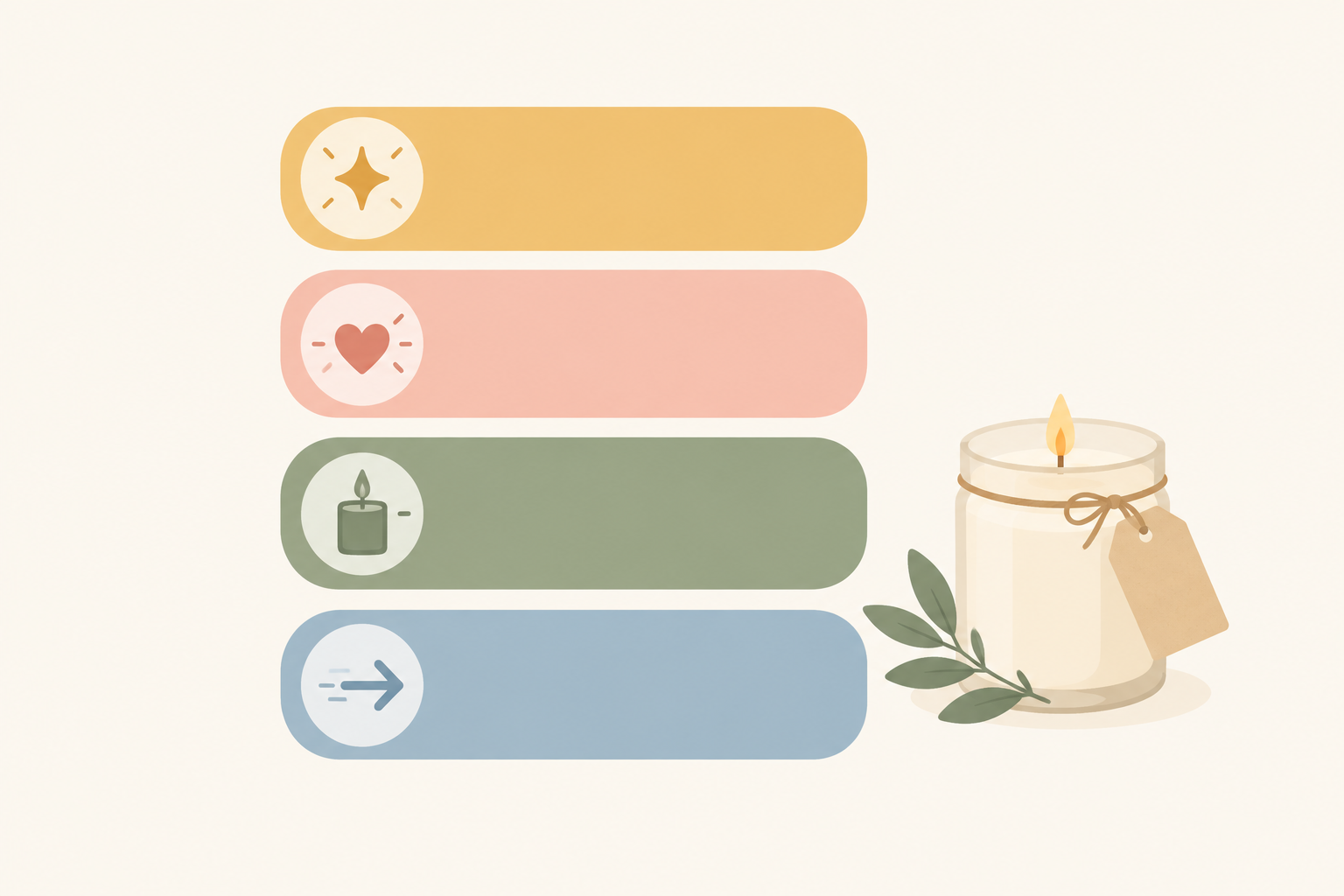
This is the framework I'd give any small business owner who says 'I'm not a writer.' There are four parts, and each one is short.
Step 1: Write a one-sentence hook
Lead with the main benefit or feeling, not the product name. For example: 'A slow-burning candle that gives a load-shedding evening a warm, cosy glow.' The hook is the first thing a buyer reads, so make it count.
Step 2: Explain the benefits in 2-3 short lines
Translate each feature into what it means for the buyer, using the pattern 'feature, so you get...'
- Cotton wick, so you get a steady flame.
- Soy wax, so it burns slowly and evenly.
- Lavender scent, so you get a soft, floral fragrance in the room.
These are illustrations. Keep every benefit honest and tied to a real feature of your product, because that's what makes it believable.
Step 3: List the product specifics
This is where the practical details live: size, weight, materials, colours, ingredients, care instructions, burn time, file format, session length. Use the measurements South Africans use (cm, g, ml) and say what's included. Don't assume buyers can work it out from a photo.
Step 4: Tell the buyer what happens next
Tell them what happens after they pay. 'Ships within 2 working days via courier.' 'Your PDF arrives by email straight after payment.' 'Pick a time slot below to book.' Only mention limited stock if it's true.
Copy-and-paste product description template
[Hook: the main benefit or feeling, in one sentence.]
[Feature], so you get [benefit].
[Feature], so you get [benefit].
[Feature], so you get [benefit].
- Size/weight:
- Materials/ingredients:
- Colours/options:
- Care/use:
[What happens next: delivery time, how it arrives, how to book.]
How long should a product description be?
Aim for roughly 50-150 words for simple items, and up to 250 for higher-priced or more complex products, services and memberships. Stop when you've answered the buyer's questions. Plenty of your customers will be reading on a phone (your own store analytics will tell you how many), so keep paragraphs short, put one idea per line, and use a bulleted spec list.
Before and after: three product description rewrites for South African sellers
Let's put the formula to work on three products most sellers will recognise. Remember, these are fictional: the burn times, ingredients and phone models are placeholders that show the style, not facts about real products.
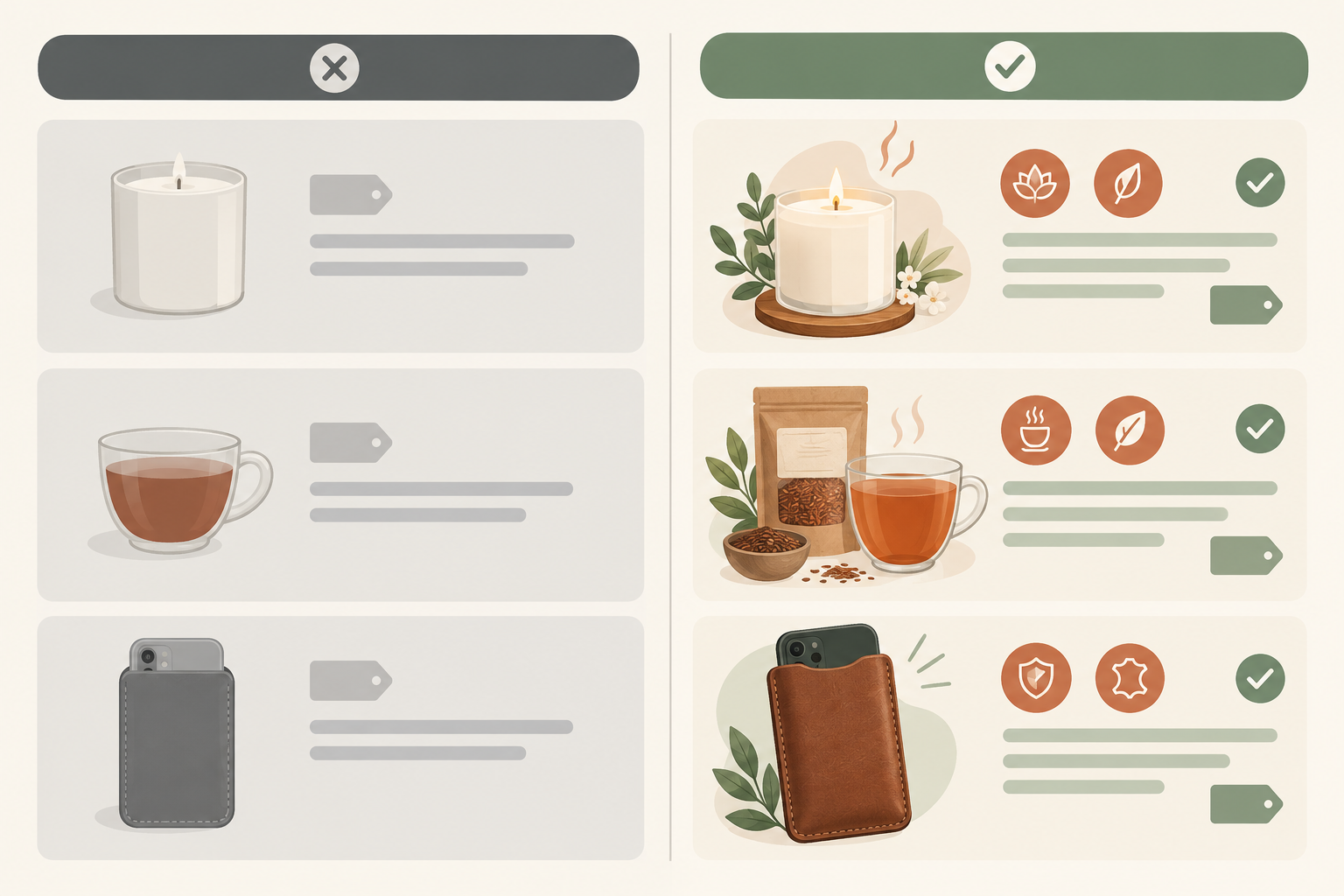
| Product | Before | After | Why it works |
|---|---|---|---|
| Handmade soy candle (R185) | 'Soy candle. Lavender. 200g. Handmade.' | Unwind after a long day with a candle that burns slowly and evenly. Hand-poured soy wax and a cotton wick give you a steady flame and a soft lavender scent. 200g, soy wax, cotton wick, lavender fragrance. Burn time: about 40 hours (tested in our own studio). Trim the wick to 5mm before each burn. Ships within 2 working days by courier. | Adds a feeling, answers 'how long will it last?' and tells the buyer what happens next. |
| Rooibos and honeybush tea blend (R95) | 'Tasty tea blend, 100g.' | A caffeine-free evening ritual in a tin. Made for anyone who wants something warm and gently sweet before bed. Honeybush brings honeyed notes and rooibos adds a smooth, earthy depth. Brew 1 teaspoon per cup in boiling water for 5 minutes. 100g tin, makes about 40 cups. Ships in 1-3 working days. | Says who it's for, describes the taste, explains how to brew, and shows value per cup. |
| Leather cellphone sleeve (R350) | 'Genuine leather phone cover, fits most phones.' | A soft-lined sleeve that keeps your phone scratch-free in a busy handbag. Microfibre lining and hand-stitched leather edges. Fits phones up to 15cm x 7.5cm x 1cm (check your model's dimensions before ordering). Available in tan, black and olive. | Swaps the doubt in 'most phones' for exact measurements and gives the buyer a real-life scenario. |
Look at what the After versions share. Each one answers a question, adds a feeling, or removes a doubt.
A word on honesty: only claim what's true. If your candle burns for about 40 hours in your testing, say 'about 40 hours', not 'burns forever'. The Consumer Protection Act (CPA) prohibits false, misleading or deceptive representations, so accurate burn times, sizes and fit protect you as well as your buyer. I cover the wider legal picture in one place further down.
Bonus: the same product description formula works for services
Before: 'Braai consult. R450.'
After: 'Never stress about hosting a braai again. In this 60-minute online consult, we plan your menu, timing and fire so you can enjoy your own party. Bring your guest count and budget. Reschedule free up to 24 hours before. Book a slot below.' R450.
Same four parts, completely different product.
Product descriptions for digital downloads, bookings, tickets and memberships
The formula bends to fit, but each type of offer has its own must-have details:
- Digital downloads (say, a R149 meal-planner PDF): state the file type, page count, whether it's printable or editable, which devices it works on, and how fast the buyer receives it. People worry about whether a download will actually open, so put their minds at ease.
- Service bookings and appointments: include session length, what to bring, whether it's in person (name the suburb or town) or online, and your cancellation and reschedule policy.
- Event tickets: lead with the date, venue and suburb, start time, what's included, age restrictions, and what happens if the event changes.
- Memberships and subscriptions: spell out what members get, how often, the billing cycle, and how to cancel. Clarity here builds trust and cuts down on refund requests.
This is where a link-in-bio store helps. With one checkout, you can describe each offer in its own plain-language way, whether that's a booking system for your sessions, ticketing for your workshop, a membership site for your regulars or downloads for your guides, while customers pay in one place. Fewer tools to juggle is a real relief when you're running things on your own.
How to make your product description stand out from competitors
Let's be honest: South African ecommerce is full of candles, tote bags and skincare. Photos alone won't separate you, but your words can.
Find your 'only we' angle. It might be your story, locally sourced ingredients (name the town or region), a small-batch process, a specific customer you serve, or a guarantee you offer.
Use specifics instead of superlatives. 'Poured in Stellenbosch, tested burn time of about 40 hours' beats 'premium quality' every time. Baymard Institute's product page research makes a similar point: concrete details like dimensions, materials, compatibility and care help shoppers compare similar products without guessing.
Mention the problem you solve that the generic version doesn't. That could be a sensitive-skin formula, sizes that suit South African homes, or packaging that survives courier handling.
Add proof where you have it. A real review, a repeat-buyer note, or a line like 'Over 300 sold' works well, provided it's accurate and you have permission.
Finally, keep your voice consistent across all your products so the page feels like one shop, not a catalogue.
Should product descriptions mention delivery, returns and legal details?
Short answer: yes. Unanswered logistics questions are a big reason people hesitate at checkout. Baymard's cart abandonment research, which draws on US shoppers, found that around 48% of those who abandoned an order cited extra costs like shipping or fees, and around 16% cited delivery that was too slow. It's US evidence, not South African, but it shows why stating costs and timeframes early is smart.
Here's the general picture. It's information, not legal advice, and how the rules apply depends on your product, your type of sale and your business, so check the sources linked below or speak to a professional.
- Delivery: state your courier or collection options, typical turnaround for main centres versus outlying areas, and the cost in rand. The CPA (section 19) deals with delivery at the agreed time or, where none was agreed, within a reasonable time, so only promise what you can meet.
- Returns and refunds: give a plain summary and link to your full policy. Don't present a blanket 'no returns' rule as if it overrides customers' rights. Under CPA section 56, goods that don't meet the implied warranty of quality may be returned within six months for repair, replacement or a refund, subject to the Act's conditions.
- Online selling rules: the Electronic Communications and Transactions Act (ECTA) requires online suppliers to make certain information available, such as the full price and terms. It also provides a seven-day cooling-off period for many distance sales, with exceptions (for example, certain services and made-to-order goods). Read the Act, or get advice, to see how it applies to what you sell.
- VAT: if you're VAT-registered, the price you display should be the full price the customer pays, including VAT at 15%. SARS sets out when registration is required.
- Customer data: only collect what you need and be clear about how you'll use it, as POPIA requires for personal information.
Keep it short on the product page, something like 'Estimated delivery: 2-4 working days. See our delivery and returns policy for details.' Put the full detail on a policy page. And a gentle reminder: I'm not a lawyer, so check current legislation or get professional advice for your specific business.
Words and phrases to avoid in product descriptions
- Vague hype: 'amazing', 'high quality', 'best ever', 'perfect for everyone'. Replace each with a measurable detail.
- Unprovable claims: 'cures', 'guaranteed results', 'the cheapest in SA'. The CPA's rules on misleading claims are a good reason to stay factual. If you say 'organic' or 'locally made', be ready to back it up.
- Jargon your buyer wouldn't use, like industry terms, unexplained abbreviations, or sizes without context.
- Pressure tactics you can't back up, such as fake scarcity or countdown timers that never end.
- Filler openers: skip 'Welcome to our store' or 'This product is...' and jump straight into the benefit.
- Walls of text. Break up paragraphs and use short lists for specs.
- Typos in prices or sizes. Read your copy aloud and ask a friend to check it before you publish, because a wrong price in rand is a headache for everyone.
How to add a product description to your Shopstar page
Once your copy is ready, here's how to get it live on Shopstar, our online store builder for people who don't want to build a full website. 🛍️
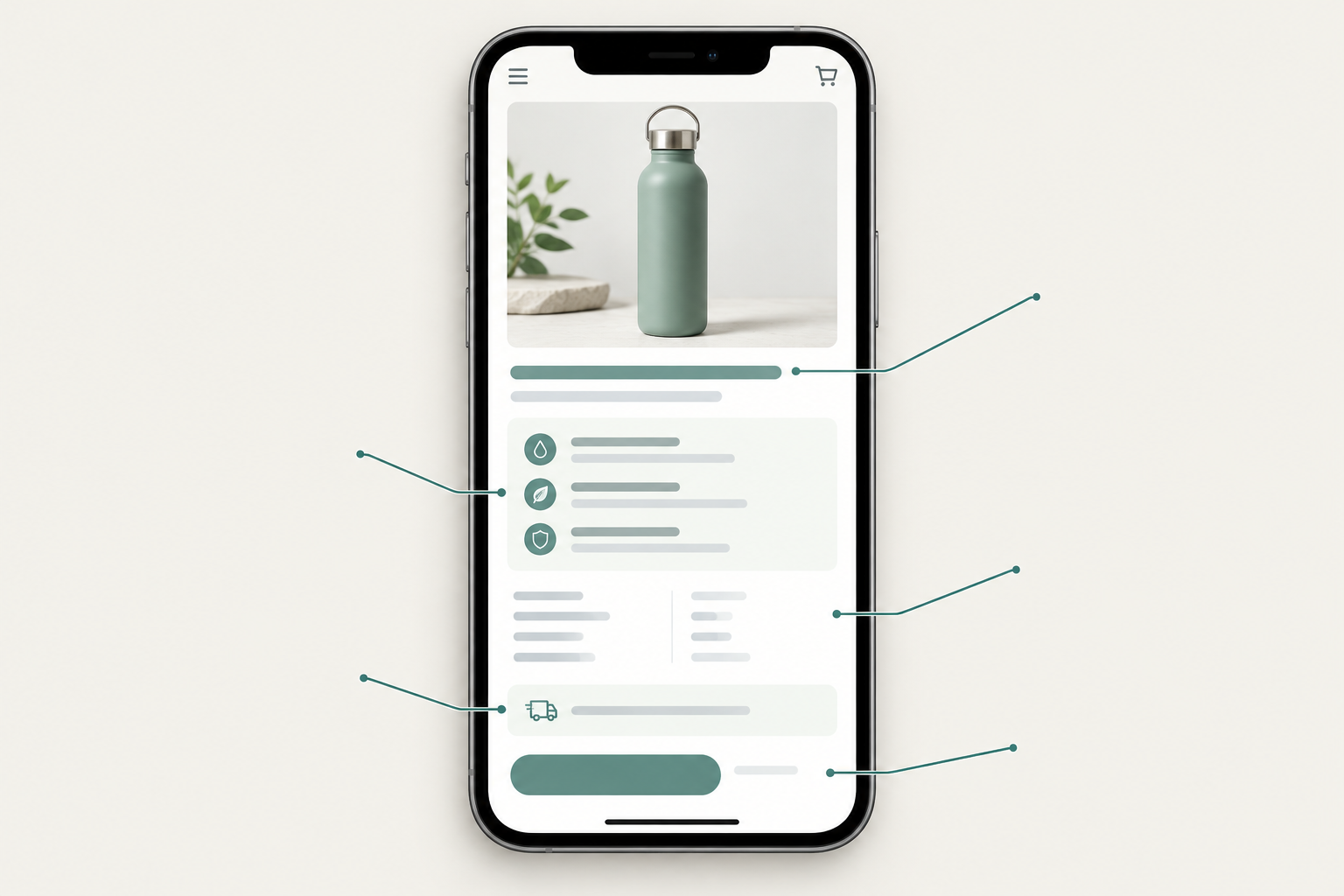
- Add your item to your Shopstar page and choose the right type: physical product, service, ticket, digital download or membership.
- Paste in your hook as the first line, since it's what buyers see first, then add your benefits and specs.
- Match your photos to your words. Show the details you mention, such as scale, texture and what's in the box.
- Use the AI tools if they help. They're handy for drafting or tidying your copy, but always edit in your own voice and double-check facts, sizes and prices.
- Preview on your phone, because that's how many of your customers will see it.
- Check your pricing against your fees. Plans and fees can change, so look at Shopstar's current pricing page before you finalise your prices in rand.
- Share your link in your bio, on WhatsApp status and on your socials, then watch which products get questions and tweak the description to answer them.
If you get stuck, our team offers hands-on support and onboarding help, so you don't have to figure out your first listings alone.
Frequently asked questions about writing product descriptions
How long should a product description be?
As long as it takes to answer your buyer's questions, and no longer. See the word-count guide in the formula section above. For a simple R95 tea tin, a few short lines usually do it.
What should I include besides product features?
Include the benefit of each feature, who the product is for, how it's used, practical specs like size, materials and care, and what happens after purchase, such as delivery time or how a download arrives. Add proof like reviews if you have them (with permission).
How do I write descriptions for products that look similar to others?
Lean on specifics and your own angle. Say where and how it's made, who you make it for, what problem it solves that the generic version doesn't, and any guarantee you offer. Concrete, verified details will set you apart faster than words like 'premium'.
Should I mention delivery and returns in my product description?
Yes. Briefly state your delivery options, timeframes and cost in rand, and summarise your returns approach with a link to your full policy. The legal section above explains the CPA and ECTA basics. Get professional advice if you're unsure how they apply to you.
Do my prices need to include VAT?
If you're registered for VAT, the displayed price should be the full price the customer will pay, including VAT at 15%. If you're not registered, you don't charge VAT. Check SARS guidance or speak to an accountant about registration.
Can I use AI to write my product descriptions?
You can use it as a starting point, especially if writing isn't your thing. Treat the output as a first draft. Add your own voice, check every fact and spec, and make sure nothing overpromises, since you're responsible for what your listing claims.
Your next step: write a product description today
Pick your best-selling product and rewrite its description today using the four parts: hook, benefits, specifics, next step. Then check your DMs in a week. If the repeat questions drop, you've got it right. If not, add the answer to the description and try again. Small tweaks, made consistently, are what turn a simple page into something that feels like a real shop. 💛