Link in Bio vs Full Website: Which Fits Your Business?
Not sure whether a link-in-bio store or a full website suits your South African business? Compare setup time, rand costs, credibility and room to grow to find the right fit for where you are now.
15 min read
On this page
Link in Bio Store vs Full Website: Which Is Right for Your South African Business?
If you're just starting out, sell a focused range of products or services, and most of your customers find you on Instagram, TikTok or WhatsApp, a link in bio store is usually the faster, cheaper and less stressful way to start selling. A full ecommerce website makes more sense once you need deeper SEO, a large catalogue or more design control. The good news? You don't have to pick forever. The right ecommerce platform lets you grow without starting over.
The short answer: it depends on where your business is right now 🤔
We get this question a lot from new sellers, and the answer is that neither option is 'better' in general. A home baker in Durban taking orders through Instagram and WhatsApp has very different needs from a Pretoria furniture retailer with 400 products who wants to rank on Google.
So treat this article as a self-assessment rather than a sales pitch. We'll look at five factors:
- Audience source: where do your customers actually find you?
- Catalogue size: how much are you selling?
- Speed: how soon do you want to start?
- Cost: what can you spend, in rand and in time?
- Room to grow: what will you need in a year or two?
By the end, you should be able to place yourself in one of three camps: start simple, run both, or go full website.
What is a link-in-bio store, really?
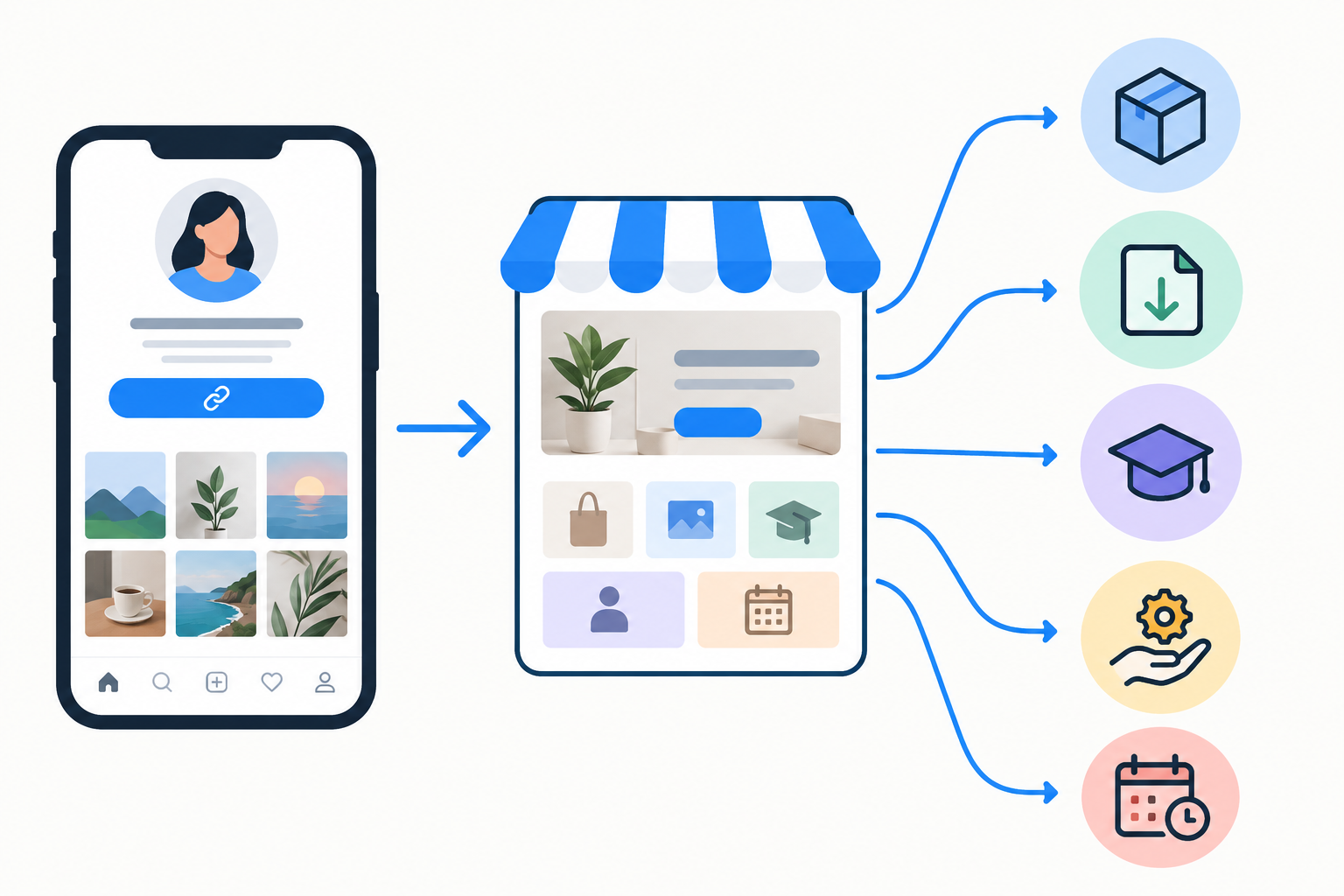
In plain English, it's a single, mobile-friendly page that you link from Instagram, TikTok, WhatsApp or Facebook. Customers can actually buy there, instead of clicking through to somewhere else.
That last part matters. Many popular tools are basically a tidy list of links: your social channels, a contact number, maybe a payment link. Useful, but not a store. A true link-in-bio store has a catalogue and checkout built in, so the journey from 'I love this post' to 'order confirmed' happens on one page.
On Shopstar, one page can sell physical products, digital downloads, memberships, subscriptions, service bookings and event tickets, all through one checkout. (Features can vary by plan, so check the current list before you commit.) A customer can buy your cookbook and book a tasting without juggling several tools.
One myth to bust: a link-in-bio store isn't a 'lite' version of a shop. It follows a different design philosophy, built for speed and simplicity, for sellers whose customers arrive on a phone, from a social post, ready to act.
What do you get with a full ecommerce website?
Here, a full website means a multi-page site: a homepage, category pages, an about page, a blog and so on, built on an ecommerce platform or through custom development.
Where it genuinely shines:
- Full design control. You decide how every page looks and flows.
- Deeper SEO potential. More pages mean more chances to appear in Google searches.
- Content marketing. A blog attracts people who are searching for answers.
- Complex navigation. Categories and filters keep large catalogues easy to browse.
The trade-offs:
- More time to build, and many more decisions to make
- Ongoing maintenance, updates and troubleshooting
- Extra apps or plugins for some features, which can add cost (and are often billed in dollars)
- Often higher running costs
If you're an established brand, have a big range or rely on search traffic, a full website is a great investment. If you aren't there yet, it can be an expensive way to delay your first sale.
Link in bio vs full website: a side-by-side comparison
Tick off the rows that matter most to you. Those are your deciding factors. Entries describe typical cases, and the details vary by platform and plan.
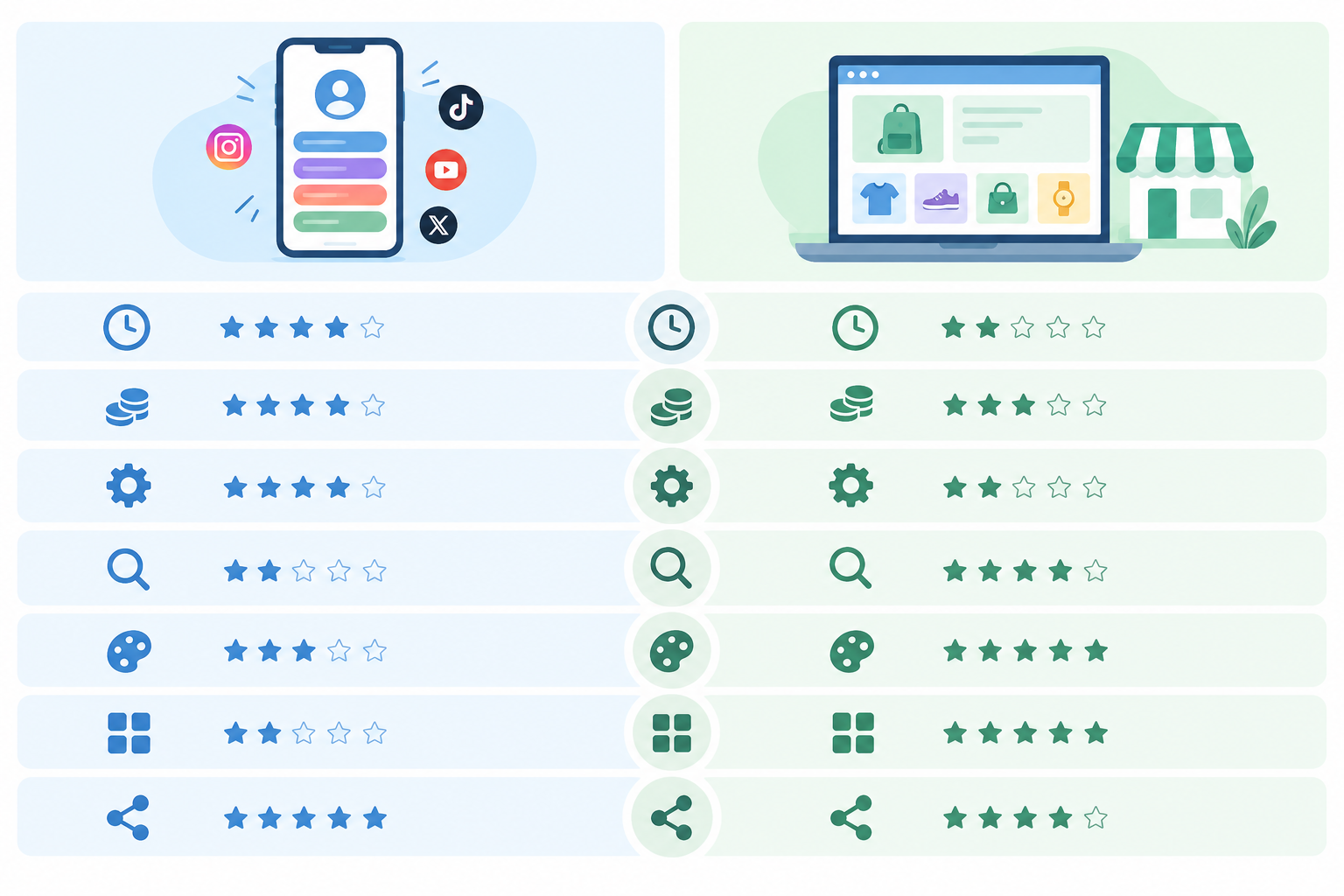
| Factor | Link-in-bio store | Full website |
|---|---|---|
| Setup time | Hours to a weekend | Days to several weeks |
| Technical skill needed | Low | Low to high, depending on platform and design |
| Upfront cost | Low | Moderate to high (theme, domain, design help) |
| Monthly running cost | Usually lower | Usually higher (plan, apps, maintenance) |
| Design flexibility | Focused, clean templates | ✅ Full customisation |
| SEO potential | Limited | ✅ Much deeper |
| Catalogue size | Best for a focused range | ✅ Best for hundreds of products |
| Social-media fit | ✅ Built for it | Works, but needs a good landing path |
| Services, tickets, digital products | Depends on platform (Shopstar covers them in one checkout) | Often needs extra apps or tools |
A full website wins on SEO, customisation and large catalogues. That's real, and we won't pretend otherwise. A link-in-bio store wins on speed, simplicity and fit for social-led selling.
One caution: a basic link-in-bio tool isn't automatically a store. Some only collect links, so check that checkout is actually included.
Is a link-in-bio page enough to look professional?
Yes, if it's done well. Customers judge trust by clarity, not page count. Nobody abandons a purchase because you have one page instead of twelve. They abandon it because the price is hidden, the photos are blurry or the checkout feels dodgy.
What builds credibility on a single page:
- Clean, bright product photos
- Clear pricing in rand, plus delivery and returns information where relevant
- Visible reviews
- A simple, familiar checkout
- A custom .co.za domain or tidy branded URL
- Consistent colours, tone and logo across your page and social profiles
Accessibility counts too. Readable text contrast and buttons big enough to tap on a phone are part of looking polished, whether you have one page or fifty.
Social proof does a lot of work on a small page. A screenshot of a happy WhatsApp message from a customer or a short testimonial near your products reassures new visitors far more than a long 'about' page would. Only use reviews you can show to be genuine.
When does a single page start to feel limiting? When customers keep asking for a blog, multiple category pages or detailed brand storytelling. That's a signal, not a failure.
Speed to launch: comparing setup times ⏱️
The times below are illustrative planning estimates, not guarantees. They assume a small catalogue, ready-to-use photos and a first-time seller. Your experience will vary.
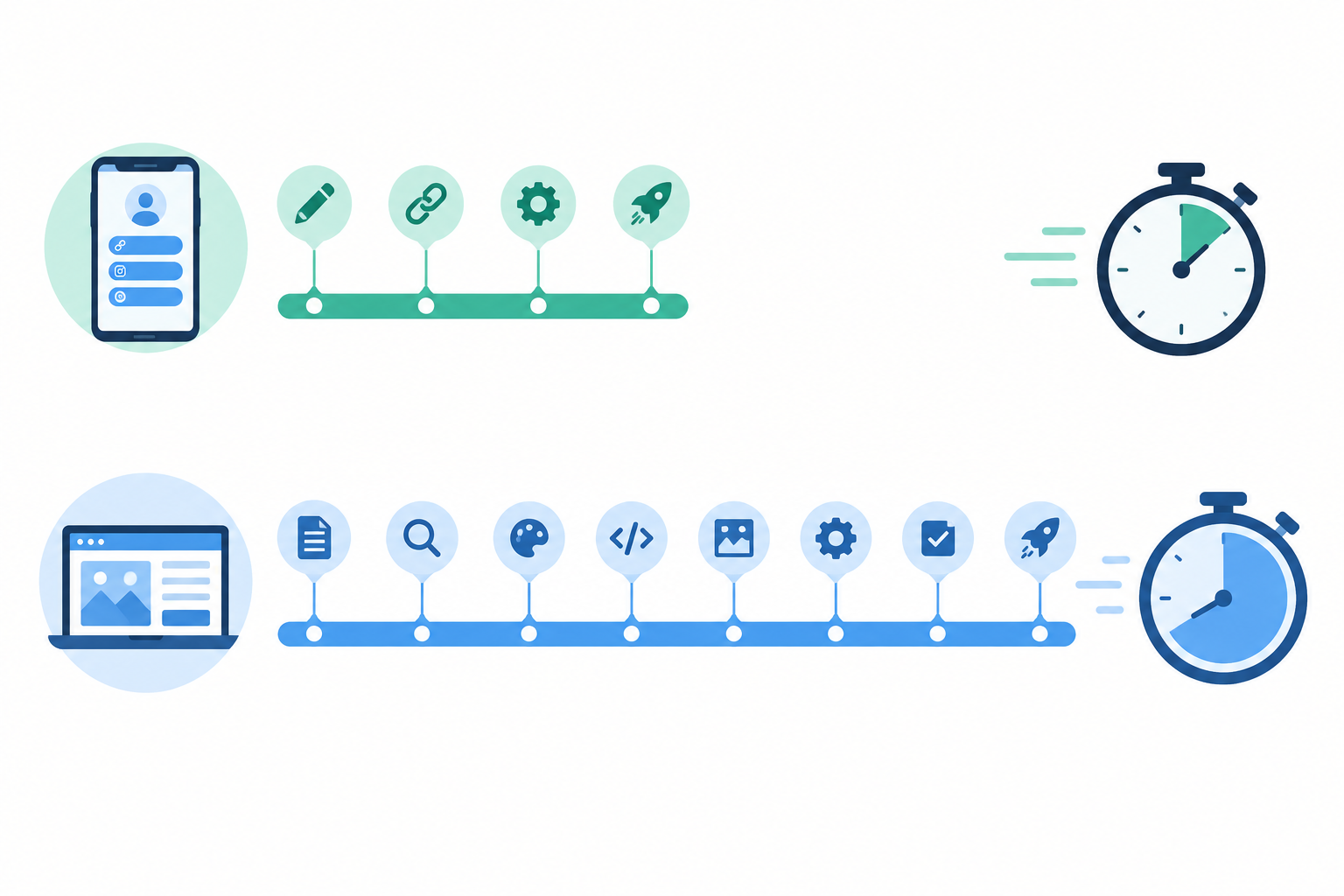
How quickly can you launch a link-in-bio store?
- Claim your URL. Pick a free branded address or connect your own domain, such as a .co.za.
- Add your products or services. Upload photos, write short descriptions and set prices.
- Connect payments. Make sure money reaches your South African bank account (on Shopstar, payments are built in).
- Share your link. Put it in your Instagram and TikTok bios, your WhatsApp Business profile and status, and your Facebook page.
A very basic page can be live in under an hour. A full catalogue may take an evening or a weekend.
Some steps aren't in your control, whichever route you take. Payment verification (confirming your identity and bank details), delivery set-up, and policies such as returns and privacy can all take longer than the page itself. South African consumer law (the Consumer Protection Act and ECTA) sets ground rules for online sales, such as a 7-day cooling-off period on many online purchases, so check what applies to what you sell. Physical products also need a delivery plan: a courier like The Courier Guy, Pargo pickup points or collection.
How long does it take to build a full website?
- Choose a platform and theme
- Plan your pages and navigation
- Write the copy for each page
- Shoot and edit photos
- Set up payments, delivery and VAT (if you're registered)
- Write policy and legal pages, including returns and privacy (POPIA)
- Test everything, especially checkout on mobile
- Launch
For a small, ready-to-sell catalogue, allow several days to a few weeks.
There's a hidden cost in all this waiting: every week spent building is a week of lost sales and lost learning. Miss the run-up to Black Friday or the December festive season and you've missed some of the busiest selling weeks of the year. Real customers teach you what to price, photograph and promote faster than any planning session can. A staged approach works well. Launch a simple page first, then build the bigger site alongside it if you need one.
One more thing: sending social traffic to a slow page costs you sales. Google's 2016 research on mobile speed (conducted with SOASTA) found that 53% of mobile visits were abandoned when a page took longer than three seconds to load. It's an older study, but the lesson holds, so test your page on your phone, on mobile data, whichever route you choose.
Cost differences over time: which option is cheaper? 💰
Costs fall into a few buckets. Here's how they typically compare:
| Cost category | Link-in-bio store | Full website |
|---|---|---|
| Platform subscription | Usually lower | Usually higher, varies by plan |
| Domain | Optional (a free branded URL may be available) | Usually wanted; some builders offer a free subdomain |
| Design / theme | Built-in templates | Free or paid themes, sometimes a designer |
| Apps or plugins | Depends on platform, often not needed | Often needed for extra features |
| Developer help | Rarely | Sometimes, especially for customisation |
| Payment processing | Percentage plus possible fixed fee | Percentage plus possible fixed fee |
A worked cost example, with the assumptions shown
These figures are made-up round numbers so you can see how costs build up. They aren't quotes from any provider, so swap in real prices from the platforms you're considering.
| Assumption | Link-in-bio store | Full website |
|---|---|---|
| Monthly plan | R150 | R450 |
| Domain (per year) | R120 | R120 |
| Theme (one-off) | R0 (built in) | R2,500 |
| Apps (per month) | R0 | R300 |
| Designer (one-off, optional) | R0 | R0 to R8,000 |
| Calculation | Link-in-bio store | Full website |
|---|---|---|
| Year one | (R150 × 12) + R120 = R1,920 | R5,400 + R120 + R2,500 + R3,600 = R11,620, or R19,620 with a designer |
| Three years | (R150 × 36) + (R120 × 3) = R5,760 | R16,200 + R360 + R2,500 + R10,800 = R29,860, or R37,860 with a designer |
The figures exclude VAT, payment processing and your time. Some platforms, including Shopstar's Start Free plan, have no monthly fee at all. Even so, the pattern is clear: fewer moving parts usually means lower costs.
Payment processing fees apply to both options
Processing fees apply either way, so compare the full fee schedule, not just the headline plan price. Here's an illustrative calculation. Say you take 100 orders of R250 in a month, which is R25,000 in sales. At an assumed 3% plus R2 per order, that's R750 plus R200, so R950 in fees. That's more than either monthly plan in our example, which is why transaction fees can matter more than the subscription as you grow.
Shopstar's two plans reflect this trade-off. Start Free has no monthly fee and costs 6% all-in per sale (a 2.9% payment gateway fee plus a 3.1% Shopstar fee), or R1,500 on that R25,000 month. Lower Fees has a monthly fee and 2.9% per sale, or R725, so it can pay for itself as sales grow.
So which option is cheaper long term? A link in bio store is usually cheaper to start and run. A full website can pay for itself once search traffic and a larger catalogue come into play, though the break-even point depends on your real order volume and average order value.
Two South African notes. VAT is 15%, and since 1 April 2026 you must register with SARS once your taxable sales pass R2.3 million in a 12-month period (you can register voluntarily from R120,000). Thresholds change, so check the current figures with SARS. And if a platform bills in US dollars, your monthly cost moves with the exchange rate, and your bank may add a foreign transaction fee.
When does a full website make more sense?
A full ecommerce website is worth considering when:
- You rely on Google search to find customers and need blog content, category pages and deeper SEO.
- You have hundreds of products, complex variants or advanced inventory needs.
- You need highly customised design, or multi-language and multi-currency selling.
- You're building a brand with a full story, including team pages, press and case studies.
- You sell B2B, with account pricing, quotes or wholesale portals.
Be realistic here. If three or more of these apply, a full website is probably worth the investment. If only one or two apply, you may be fine with a simple page now and a bigger site later.
When is a link-in-bio store the smarter choice? 📱
A link-in-bio store is probably your best fit when most customers come from Instagram, TikTok, WhatsApp or Facebook, you sell a focused range, and you want to test an idea quickly without a big build. It also suits solopreneurs, creators and service providers who don't have the time or technical confidence to manage a website.
Picture Thandi, a fitness coach in Johannesburg. She runs 1:1 sessions, sells a 6-week workout PDF, offers a monthly membership with weekly classes in her local park and hosts a quarterly weekend retreat in the Magaliesberg. On a traditional site she'd need a booking tool, a download store, a membership plugin and a ticketing app. With a single page on an ecommerce platform like Shopstar, her followers tap the link in her Instagram bio and can book, download, subscribe or buy a ticket through one checkout. One page, one link, one place to see her orders.
The same goes for a Gqeberha baker taking weekend orders, or a Cape Town event host selling tickets and merch for a Heritage Day market.
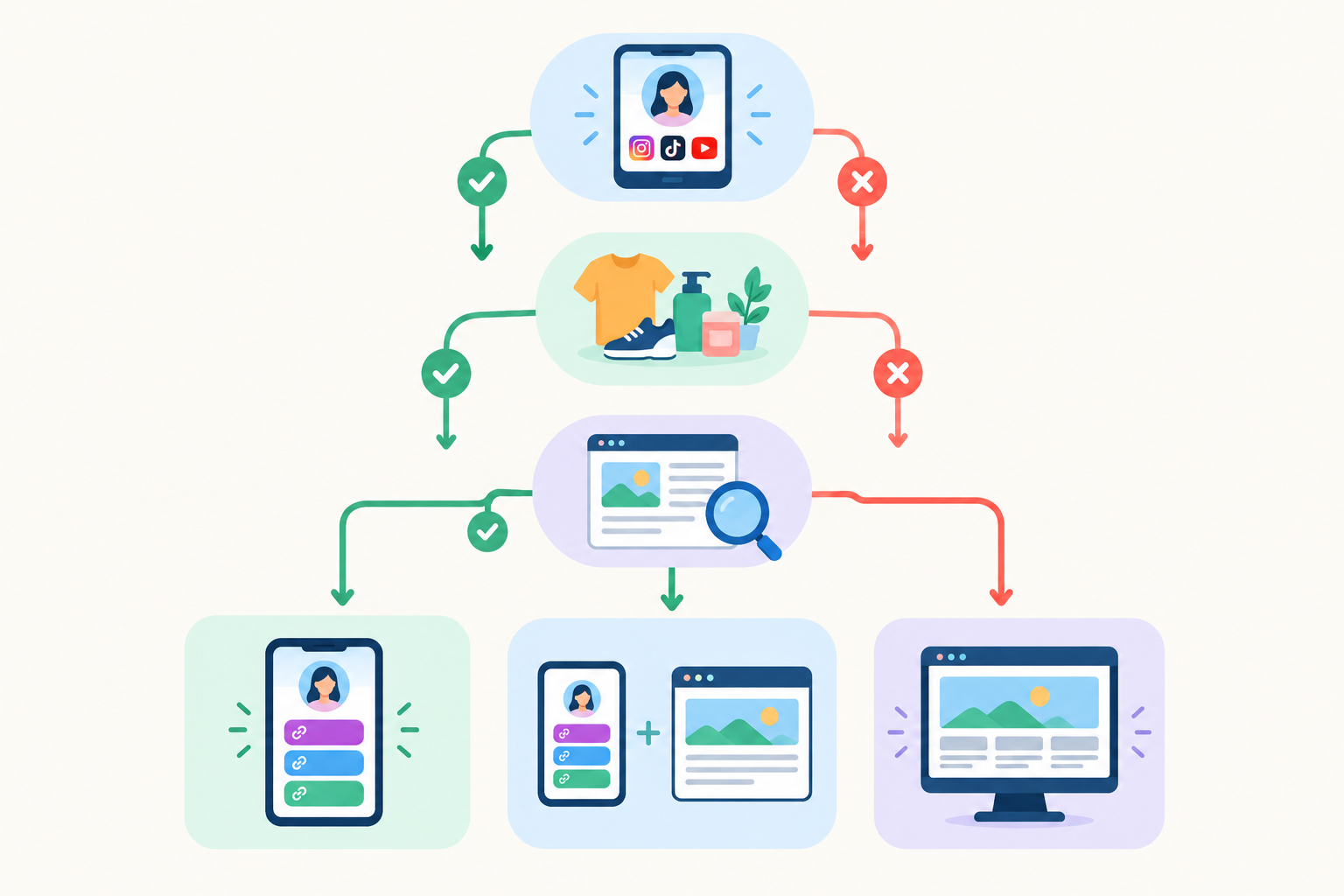
Quick self-assessment: which option suits your business?
Answer these six yes/no questions, then score yourself using the rubric below.
- Do most of your customers find you on social media?
- Do you sell fewer than 20 items or offers?
- Do you need a blog or search traffic to attract customers?
- Do you need heavy design customisation, or multiple languages or currencies?
- Do you already have a website?
- Do you want to start selling in the next week or two?
Step 1: Work out two scores.
- Link score: one point for each 'yes' to questions 1, 2 and 6 (0 to 3).
- Website score: one point for each 'yes' to questions 3 and 4 (0 to 2).
Step 2: Find your result.
| Your scores | Your camp | What to do |
|---|---|---|
| Website score 0, link score 2 or 3 | Start simple | Launch a link-in-bio store. If you said yes to question 5, you're in the 'run both' camp below: keep your site and add the store as your social checkout. |
| Website score 2, link score 0 or 1 | Go full website | You're search-driven or need deep customisation. Plan the build properly. |
| Anything in between, including a small catalogue with strong SEO needs | Run both | Launch a link-in-bio store now to start selling and learning, and build your website in stages. |
| Website score 0, link score 0 or 1 | Either could work | Your needs don't point strongly either way. Choose the faster, cheaper option and revisit in three months. |
Question 5 never decides your camp on its own. Having a website doesn't mean it's working for you, and a small catalogue doesn't rule out a website if SEO matters. Businesses change, so retake this every six months. Today's 'start simple' can easily become next year's 'run both'.
Can you switch from a link in bio to a full website later?
Yes, mostly, and this is the bit we most want to reassure you about. Starting simple isn't a dead end.
What usually carries over when you grow:
- Your customer list, if your platform lets you export it (check before you commit)
- Product photos and descriptions
- Brand assets like your logo, colours and tone of voice
- Reviews and testimonials you hold copies of
- Your domain, if you own it and connect it yourself
Many growing businesses take a hybrid approach. They add a bigger site for blog content and detailed pages, but keep the link-in-bio store as the fast social storefront. The link in bio handles quick actions from social, while the website holds the detail.
To be fair, some things may need rebuilding: your design, page structure and any SEO content. And moving a domain involves DNS changes and a little downtime planning, so allow time for it. But you'd build those parts fresh anyway, once you know what your customers actually want.
Can I use a custom domain with a link-in-bio page?
Often, yes, though it depends on the platform. Many let you use a free branded URL or connect your own domain, and Shopstar offers both: a free shopstar.page address or your own domain.
A custom domain helps for a few reasons. People trust it more, because yourbrand.co.za looks more established than a long platform address. It's easy to remember, so people can type it from a market-stall banner or a flyer, or say it in a WhatsApp voice note. And it's portable: if you own the domain, you can usually point it at a new platform later.
Connecting a domain is less scary than it sounds. You buy or already own a domain, then point it at your page by changing a couple of settings with your domain provider. Exact steps vary by provider, so use your platform's guide or ask its support team.
Choosing an ecommerce platform in South Africa: what to check ✅
Whichever platform you're looking at, local or international, confirm these things before you commit rather than assuming:
- Whether you can charge in rand and get paid into a South African bank account, and how often payouts arrive
- Which payment methods your customers can use at checkout, including cards and QR payments
- Whether you have to open and manage a separate payment gateway account
- How delivery works, from courier rates to pickup points
- How VAT, delivery and returns information are displayed
On Shopstar, you sell in rand and customers pay by card, Apple Pay (on compatible devices) or Scan to Pay. Payments are built in with Shopstar Go, so there's no separate gateway account, and payouts reach your South African bank account automatically every day. Connect a Bob Go account and courier rates show at checkout. Run the same checklist on any provider in the South Africa ecommerce market.
My take: start where you are, grow when you need to ✨
If your customers come from social, your range is focused and you want to start quickly, begin with a link-in-bio store. If you rely on search, have a big catalogue or need deep customisation, a full website is worth building. If you're somewhere in between, run both.
The best choice is the one that gets you selling this week, not the one that sounds the most impressive. You'll learn more from your first ten orders than from months of planning.
If you'd like to try it, you can build a Shopstar page on the Start Free plan, with no monthly fee, and our team will help you get set up. We'd love to see what you create.
Wishing you your first (or next) sale soon,
The Shopstar team 💜
Frequently asked questions
Will I need a full website eventually?
Not necessarily. If your customers mostly find you on social media and you sell a focused range, a link-in-bio store may be enough for years. If you start to depend on search traffic, a blog or a large catalogue, a full website becomes worth considering.
Can I sell services and digital products, or only physical goods?
On Shopstar you can sell services, digital downloads, memberships, event tickets and physical products. Some other tools only handle one or two of these, so check what's included in checkout.
Do I need technical skills to set up a link-in-bio store?
No. These stores are designed for non-technical owners, and Shopstar offers onboarding support if you get stuck.
Do I need to charge VAT?
It depends on whether you're VAT registered, which is based on your turnover. Since 1 April 2026, registration is compulsory once taxable sales pass R2.3 million in 12 months (voluntary from R120,000), and the rate is 15%. Check the current rules with SARS or ask an accountant, as a platform can't decide this for you.
Can I take my customer data with me if I leave a platform?
Usually you can export customer and product data, but formats and limits vary. Ask any platform about export options before you sign up, so you're never locked in. And wherever it's stored, POPIA applies to the personal information you hold.