Physical Products or Digital Downloads: What Should You Sell First in South Africa?
Compare physical products vs digital downloads in South Africa, from startup costs and shipping to margins and effort, and choose a practical first of
13 min read
On this page
Physical Products vs Digital Downloads: What Should You Sell First in South Africa?

If you have no stock, little cash and a skill or bit of knowledge people will pay for, start with digital downloads. They usually avoid per-unit stock and delivery costs, though you'll still have fees, creation time, marketing and customer support. If you already make or source something people love, start with physical products and keep delivery simple. You don't have to choose forever, either. An ecommerce platform can let you sell both from the same page.
Below, I'll walk through the trade-offs in rand so you can compare physical products vs digital downloads and pick a starting point based on your cash, time and skills. This is general information, not legal, tax or financial advice, so check the details with a professional for your own situation.
Physical Products vs Digital Downloads: The Quick Answer 🤔
Think of this as a starting-point decision, not a life sentence. Plenty of sellers begin with one type and add the other once they know their customers. A candle maker adds a printable gift-planning guide. A study-guide creator adds a printed workbook.
Three things decide which route suits you best:
- Upfront cost: how much cash you tie up before your first sale.
- Ongoing effort: stock, packing, shipping, returns and customer support.
- Margin: what's left after product costs, delivery and fees. Margins vary a lot by product and price, so work yours out rather than assuming.
If you're somewhere in the middle, the questions near the end will help you break the tie.
The market is on your side either way. World Wide Worx reported that South African online retail reached roughly R71 billion in 2023, up about 29% on 2022 (World Wide Worx). DataReportal estimated around 45 million South Africans (about 75% of the population) were online at the start of 2024 (DataReportal: Digital 2024 South Africa). Those numbers tell us plenty of people shop and browse online. They don't prove anyone wants your particular product, so you'll still need to test that.
The Case for Starting With Physical Products
There's a reason so many small businesses begin with something you can hold. South African shoppers love backing local makers: candles from Durban, skincare from Cape Town, streetwear from Joburg. A tangible product feels real, and that counts for a lot when someone is deciding whether to trust a new seller.
What physical products have going for them:
- They're easy to show and explain. Shoppers can judge size, materials and function from clear photos, a short video and a couple of customer reviews.
- Word of mouth and local markets feed your page. Someone buys at a Saturday market, then orders again through your link in bio.
- They suit gifting and repeat purchases. A product people can unwrap works well for bundles and add-ons, and Yuppiechef, the South African kitchenware retailer, built a whole brand around curated physical products.
- Local testing is straightforward. You can start with a small batch or pre-orders, see what sells, then expand.
The honest downsides:
- You need money for stock upfront, and unsold stock is cash you can't use.
- You'll deal with storage, packaging, courier bookings, lost or damaged parcels and returns.
- The Consumer Protection Act (CPA) gives buyers an implied warranty of quality, so if goods turn out to be defective you may have to repair, replace or refund them. The National Consumer Commission publishes plain-language guidance.
Best fit: people who already make, source or resell something with proven local demand.
Physical Product Example: The Gqeberha Home Baker
Picture a home baker in Gqeberha who already sells to friends and neighbours over WhatsApp. She puts a link in bio on Instagram, lists three bundles (a dozen cupcakes, a celebration box, a cookie tin), and takes orders for Friday and Saturday delivery. She limits delivery to a few suburbs and offers free collection, which keeps courier headaches away. For this illustration, assume her ingredient costs are manageable and she quickly learns which bundle people actually want. (She's a made-up example, not a real case. A real food business should also check local food-handling and registration requirements with her municipality.)
The Case for Starting With Digital Downloads
Digital downloads are products you create once and deliver again and again: spreadsheets, PDFs, templates, presets, audio packs. There's no stock, no packaging and no courier, so you can launch with very little upfront cash. Your biggest investment is your time.
Delivery is the part I like best. Customers get their file straight after checkout, even when you're offline or the power is out during load shedding. You're not racing to the post office before it closes.
Digital download ideas for South African sellers:
- Budget spreadsheets built around rand incomes and local expenses
- Matric study guides and summary notes
- Meal-plan PDFs with ingredients from Checkers or Woolworths
- Lightroom presets
- Invoice, quote and social media templates for small businesses
- Printable planners
- Music packs or voice-note meditations
Treat these as ideas to test, not proof of demand. Ask a handful of people if they'd pay before you spend weeks creating anything.
The honest downsides:
- Files are easy to copy, and free content online puts pressure on your price.
- You have no physical product to show, so you need to build trust with previews, sample pages and reviews.
- It isn't automatically passive. You still have to create something genuinely useful, market it and answer customer questions.
A legal note: the Electronic Communications and Transactions Act (ECTA) gives buyers a cooling-off right for many online purchases, but it has exceptions for certain goods and services, and the CPA may still apply. Whether and how this applies to a downloadable file isn't always clear-cut. Read the ECTA and the NCC's guidance, state your refund and cooling-off policy plainly on your page, and check with a legal professional before you set a no-refund policy.
Digital Download Example: The Cape Town Photographer
Imagine a Cape Town photographer who spends a weekend building a preset pack for moody mountain-and-sea edits. She prices it at R180, adds before-and-after previews, and shares it with her Instagram followers. The pack is made once, so each later sale has low incremental fulfilment costs, before platform fees, support and marketing. The catch is that she still has to keep showing her work to attract buyers. (Again, an illustration.)
Comparing Startup Costs, Margins and Effort
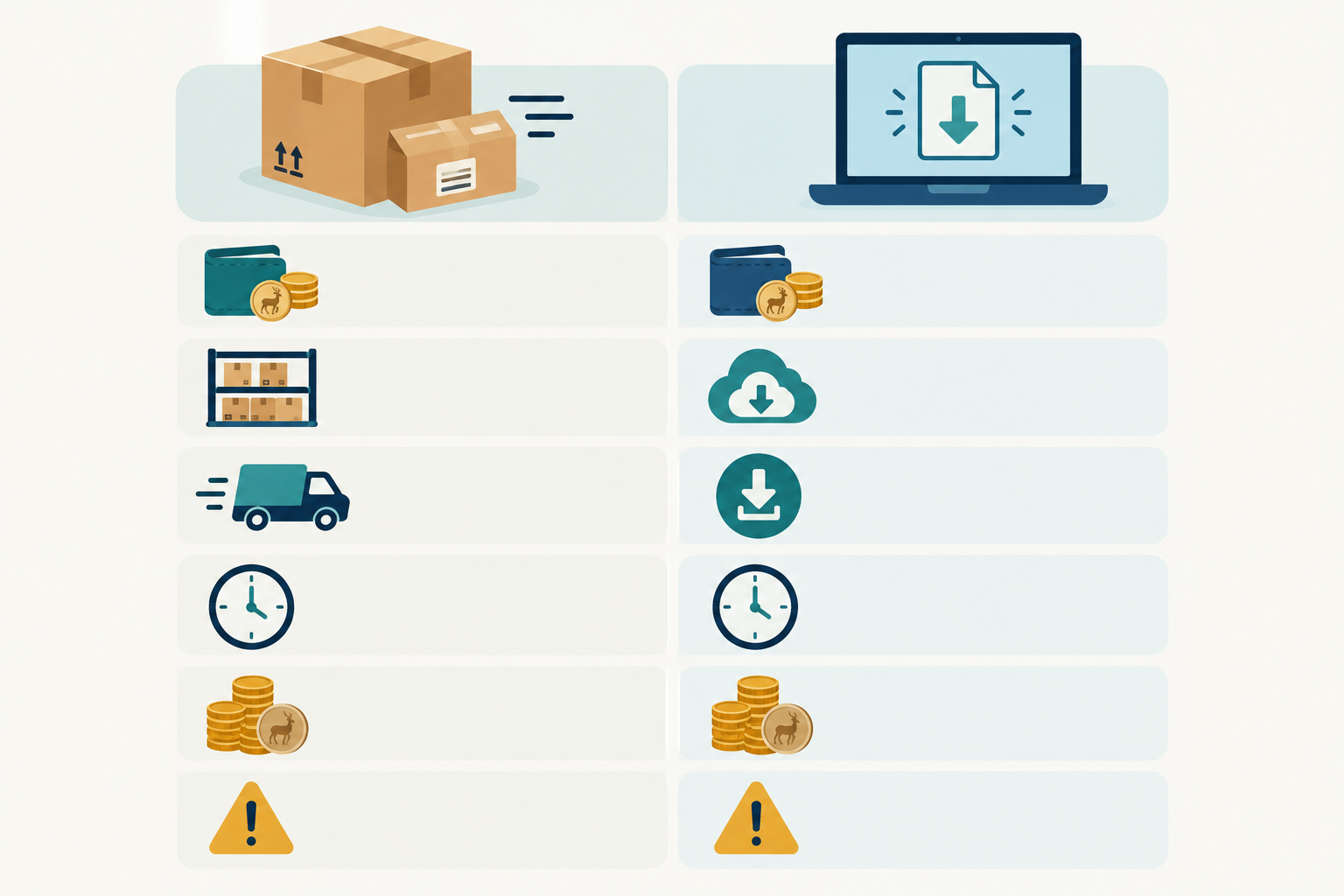
Here's a side-by-side comparison of physical products vs digital downloads:
| Physical products | Digital downloads | |
|---|---|---|
| Upfront cost | Stock, packaging, samples | Your time, maybe design software |
| Stock and storage | Yes, you need space and cash | None |
| Delivery | Courier, pick-up point or hand delivery | Instant, automatic |
| Time per order | Packing, labelling, handover, tracking | Low, though support questions still come in |
| Typical margin | Varies; often squeezed by stock and delivery costs | Varies; often higher per sale, since there's no stock or delivery |
| Scalability | Limited by stock, time and logistics | Limited mainly by your audience |
| Main risk | Unsold stock, delivery problems, returns | Low visibility, copying, trust |
A Simple Rand Example: Comparing Profit Margins
Let's compare two R250 sales. For the physical product, say it costs you R100 to make or buy, and you absorb R60 for the courier. For the digital template, assume no per-sale product or delivery cost.
On Shopstar's Start Free plan, fees are 6% all-in per sale (a 2.9% payment gateway fee plus a 3.1% Shopstar fee). That's R15 on a R250 sale. On the Lower Fees plan it's 2.9% per sale, about R7.25, but you pay a monthly fee. Check current pricing on Shopstar's site before you decide.
These are estimated amounts remaining after only the costs listed. They are not profit:
- Physical (Start Free): R250 − R100 − R60 − R15 = R75
- Physical (Lower Fees): R250 − R100 − R60 − R7.25 = R82.75
- Digital (Start Free): R250 − R15 = R235
- Digital (Lower Fees): R250 − R7.25 = R242.75
What's missing from every line: packaging, your own labour, marketing, customer support, any software or design tools, and tax. For digital, add the weeks you spent creating the file and the effort of promoting it. Real net profit will be lower, so use these figures to compare the two models, not to forecast your income. If your customer pays the courier fee, the physical figures improve, but price delivery carefully so it doesn't put buyers off.
Is the Lower Fees plan worth it? The saving on a R250 sale is about R7.75 (R15 minus R7.25). Divide the plan's monthly fee by that number to find your break-even. As a purely hypothetical example, if the monthly fee were R200, you'd need roughly 26 sales of R250 a month before it paid off. If you're not near that volume, Start Free is likely the safer place to begin.
The Catch With Digital Product Margins
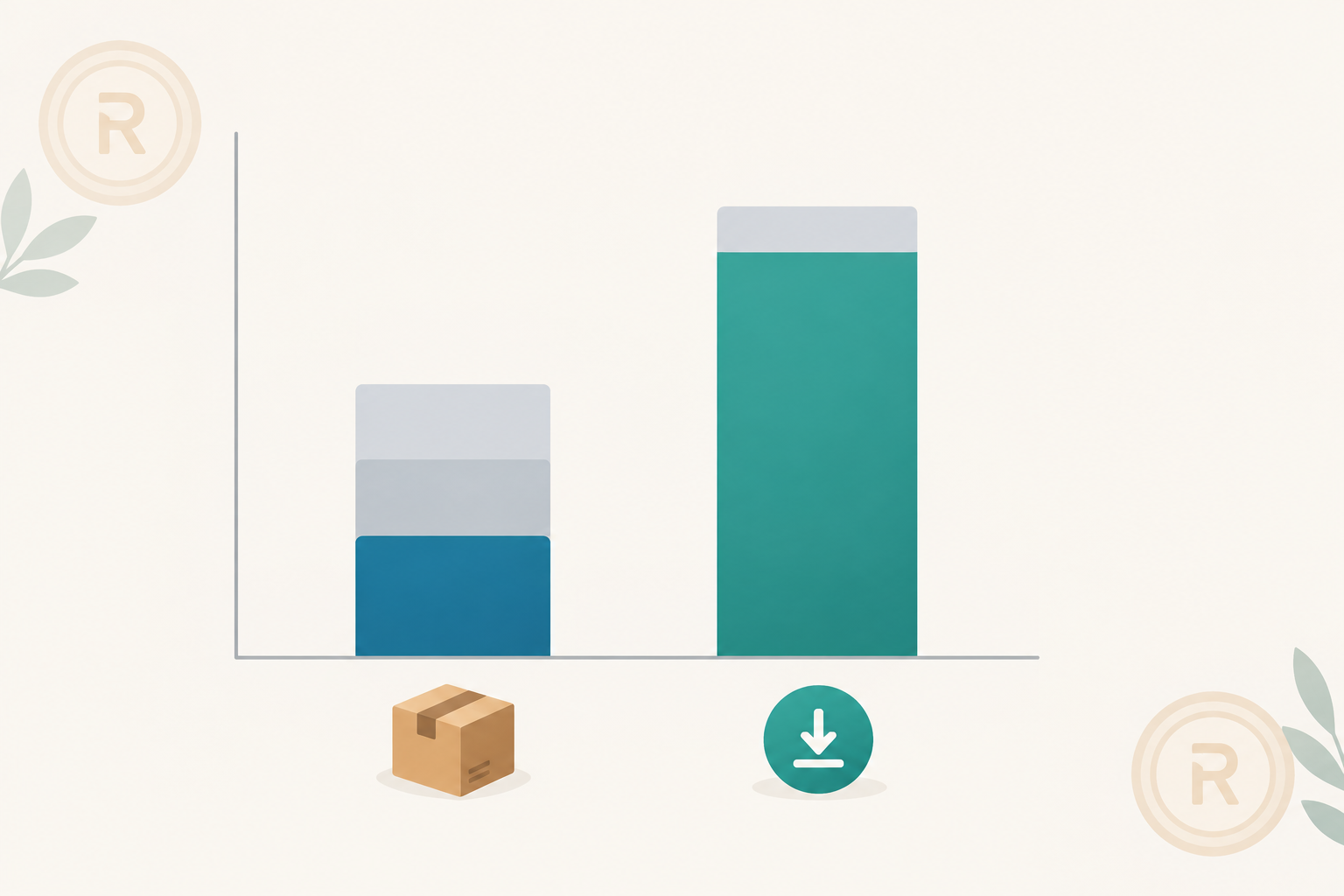
A higher margin per sale doesn't mean easier income. With digital downloads you often have to put more work into building an audience, because you're attracting buyers with content, previews and trust. A physical product can sell off a market table or through a friend's recommendation. A PDF usually needs you to show up consistently online.
A Quick Word on VAT for South African Sellers
VAT in South Africa is 15%. Registration is compulsory when your taxable turnover passes R1 million in a consecutive 12-month period, and voluntary registration is possible earlier (from R50,000, subject to SARS requirements). Being unregistered doesn't mean tax stops mattering. SARS still expects proper income records and income tax returns, so track every sale from day one. See SARS guidance on VAT registration and speak to an accountant about what applies to you.
Shipping Challenges With Physical Products (and How to Manage Them) 📦
Delivery is where new physical sellers most often get hit with unexpected cost and friction. Courier fees vary with size, weight and distance, and parcels can be delayed, damaged or returned.
It affects sales too. Baymard Institute's research on cart abandonment found that about 70% of online carts are abandoned, with 48% of surveyed shoppers citing extra costs like shipping, taxes or fees, and 22% citing delivery that was too slow (Baymard Institute). That's global data, not South Africa-only, but the lesson travels well: show the full delivery price and timeline early.
Physical Product Delivery Options in South Africa
- Courier door-to-door is convenient for buyers but usually the priciest option. Aggregators like Bob Go can help you compare couriers.
- Pick-up points and lockers, from services such as Pargo and PUDO, are often cheaper and let buyers collect when it suits them. Check current coverage and pricing.
- Local hand delivery and collection works well for a Gqeberha baker or a Joburg candle maker serving nearby suburbs, and free collection costs you nothing in courier fees.
Why Distance Matters for Shipping Costs
As a rough illustration only, a small parcel from Joburg to Pretoria might cost somewhere around R60 to R80, while Joburg to Cape Town could be R100 to R150 or more, depending on size, weight and service level. These aren't quotes. Get a current quote from your courier or aggregator for your actual parcel.
Practical Shipping Tips for Small Businesses
- Weigh and measure your packaging before you price, and use the real parcel dimensions.
- Set flat or tiered delivery rates by region so checkout stays simple.
- Offer free collection wherever it's realistic.
- Build a buffer into your prices for the odd lost or damaged parcel.
- State delivery timelines and returns terms clearly. The CPA expects honest, upfront information about price, delivery and consumer rights, and this keeps you on the right side of it.
One more thing. You're collecting customers' names, addresses and phone numbers, which count as personal information under the Protection of Personal Information Act (POPIA). Only collect what you need, keep it secure, and don't share it carelessly.
Which Is Easier to Start With if You Have No Experience?
Digital is usually easier operationally. Physical is often easier to explain and sell to people you already know. Which is easier for you depends on what you're missing:
- No money: lean digital, since you can start without buying stock.
- No skills, but you have a supplier: lean physical. You can resell something people already want.
- No audience: neither is easy, so start with a small circle of friends, family, a WhatsApp group or a local community page.
The real beginner hurdle isn't logistics. It's finding out whether people want what you're selling. So test with a small first offer, like five units of a physical item or one simple PDF at a low price such as R79 to R150. See who buys, ask why, and improve from there.
Can You Sell Physical Products and Digital Downloads Together?
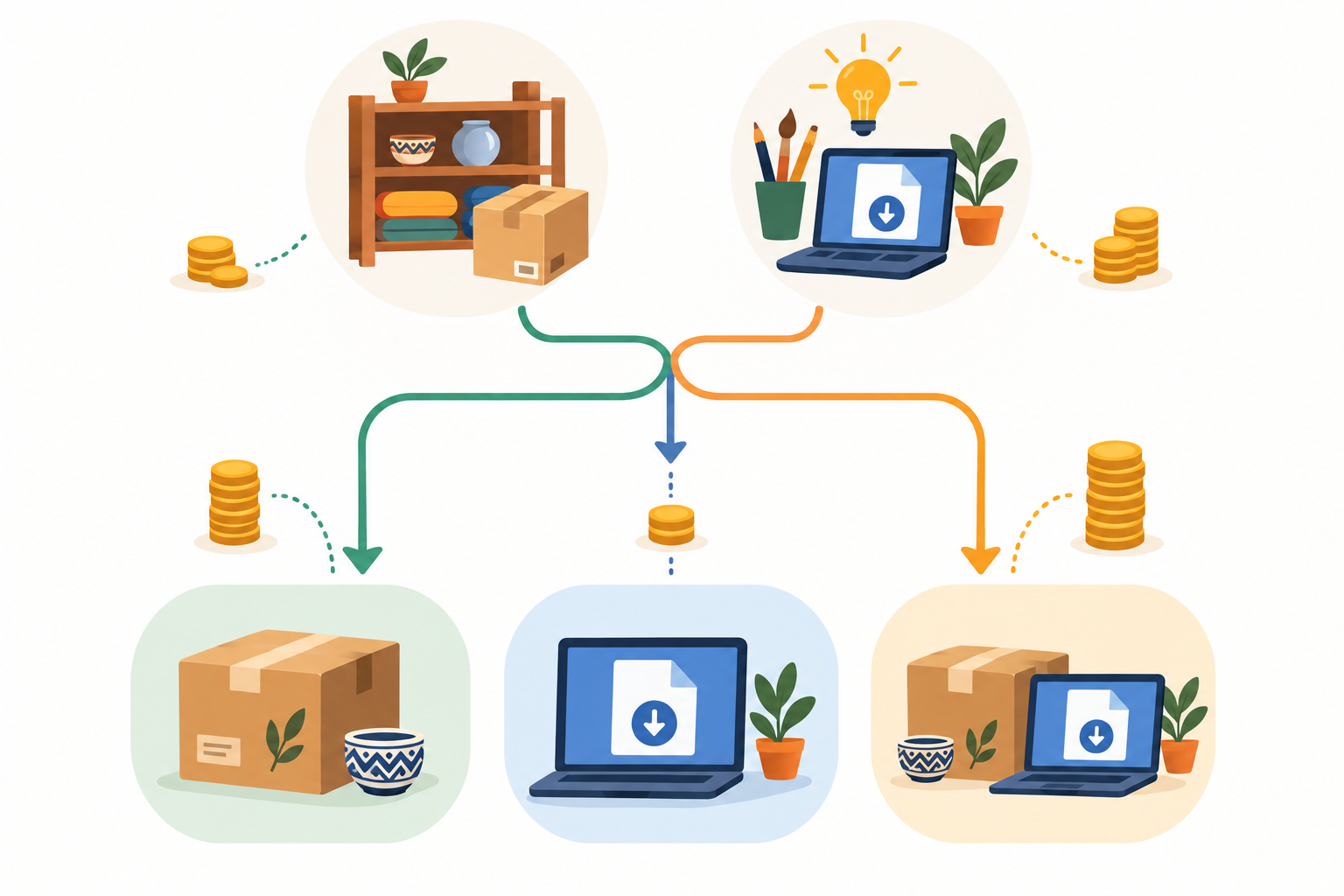
Often, yes. Many ecommerce platforms let one page sell physical and digital items, so a customer can buy, say, a candle and a downloadable care guide in the same order. Check how your chosen ecommerce platform handles mixed carts, delivery settings and digital file access before you commit.
A few pairings that work well:
- A physical product plus a digital guide (skincare plus a routine planner)
- A workshop ticket plus a workbook
- A service booking plus a template pack
Shopstar is one example. It's an online store builder where you can claim a shopstar.page URL or connect your own domain, and sell physical products, digital downloads, memberships, bookings and event tickets from one page. It offers built-in payment processing through Shopstar Go and payouts to a South African bank account. Confirm the current features and payout terms on Shopstar's site.
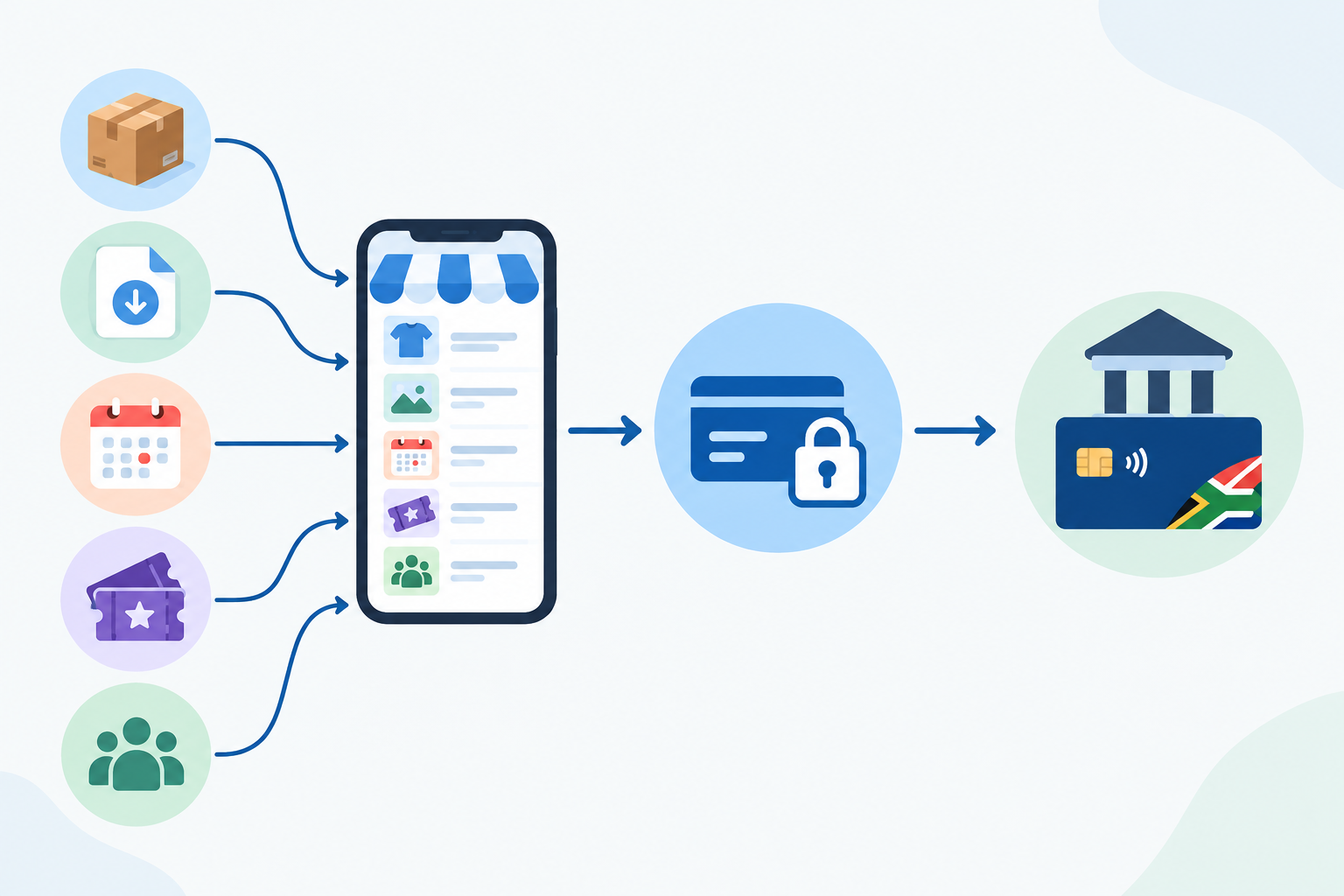
Switching later is straightforward. Start with the easier offer, learn what your customers want, then add the second product type. My one caution: don't launch ten things at once. Begin with one hero product and one add-on. That's enough to learn from.
Questions to Ask Before Choosing What to Sell
Grab a notepad and answer these honestly:
- How much money can I afford to tie up before my first sale? If the answer is very little, digital looks better.
- Do I already have a product, skill or knowledge people have asked me for? Whatever people already ask you for is usually your best starting point.
- How do I feel about packing, queuing at the courier and handling returns? If the thought drains you, that tells you something.
- Who is my first buyer, and where do they already spend time? WhatsApp, Instagram, TikTok or local markets: pick the place you can reach them today.
- What price can my buyers realistically pay in rand, and what is left after fees, costs and delivery? Work out the margin per order, not just the selling price.
- Can I test this in one week with a simple offer? If yes, you're ready.
If most of your answers point one way, start there and revisit the decision in 90 days, once you have real sales data.
Your First Week: A Simple Ecommerce Launch Plan
You don't need a perfect launch. You need a live page and a few real customers.
- Pick one offer and one price in rand. Resist the urge to list everything.
- Set up your page. Add clear photos or a preview of the file, and connect payments.
- Write plain-English delivery, refund and privacy details. Say what buyers get, when, and what happens if something goes wrong.
- Share your link in your bio and with your first 20 contacts. Personal messages beat generic posts.
- Track what sells. Ask buyers for feedback, then decide what to add next.
If you're not technical, look for a platform with onboarding support so you're not figuring it out alone. Shopstar offers hands-on onboarding, for example.
Frequently Asked Questions About Physical Products and Digital Downloads
Which is easier to start with if I have no experience?
Digital downloads are usually easier operationally because there's no stock, packing or courier. If you already have a product people want, physical can feel more natural. See the section above for the no-money, no-skills and no-audience cases.
How much profit margin do digital products offer?
It varies, but per-sale margins are often higher because you don't pay for stock or delivery. Your costs are your creation time, marketing, support and payment fees. On Shopstar's Start Free plan, fees are 6% all-in per sale, so a R200 download leaves about R188 after fees, before tax and your other costs.
What are the shipping challenges with physical goods?
Courier costs that vary by size, weight and distance, delays, damaged parcels and returns. Plan your packaging, set clear delivery rates and timelines, and consider collection or local delivery to keep costs down.
Can I switch from physical products to digital downloads later?
Yes. Many sellers start with one type and add the other once they understand their customers. Look for an ecommerce platform that lets you add new product types to the same page without rebuilding your store.
Do I need to charge VAT in South Africa?
VAT at 15% applies once you're registered. Registration is compulsory when your taxable turnover passes R1 million in a 12-month period, and voluntary earlier. Keep good records for SARS and speak to an accountant.
The Bottom Line: Choose the Right Product to Sell First
Pick the offer that matches the cash, skills and energy you have right now, launch it small, and let your first customers tell you what to add next. 🚀