Shipping Products in South Africa: A Practical Guide for Small Sellers
Shipping products in South Africa? Compare couriers, pickup points and local delivery, calculate parcel costs, choose flat-rate or free shipping, and set clear delivery expectations.
14 min read

On this page
The simplest way to start shipping products in South Africa is to weigh and measure your packed parcels, compare a courier, a pickup-point network and your own local delivery or collection, and then offer one clear shipping option that customers understand at checkout. When shipping products South Africa-wide, most small sellers do best with a flat rate (or a free shipping threshold built into their prices) and a short, honest delivery promise. Pack well, track every parcel, and keep a calm plan for when something goes wrong.
That's really all there is to it. The rest of this guide walks through each piece with rand examples, so you can ship from a link in bio page or a simple online store without feeling overwhelmed. 📦
Start here: measure parcel sizes and weights
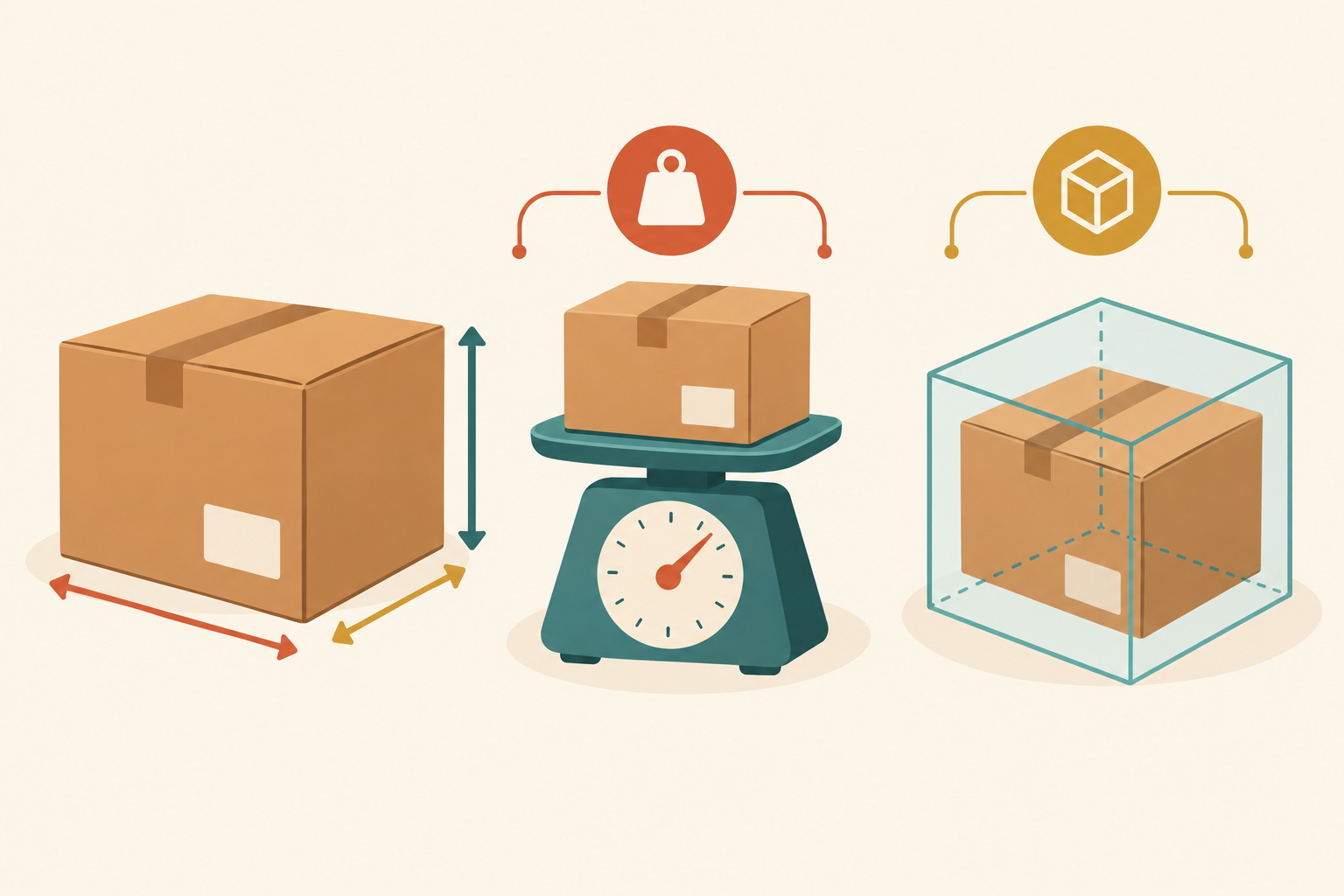
The most common mistake I see is guessing the parcel size instead of measuring it. A candle set that 'feels light' can still be quoted as a much bigger parcel once it's in a box. So before you compare a single courier, do this:
- Pack one real order. Use the box, filler, tape and everything else that will actually go out the door.
- Weigh the finished parcel on a kitchen or postal scale. Packaging changes the weight more than you'd think.
- Measure the outside of the box in centimetres: length, width and height.
- Work out the volumetric weight. Couriers often charge for whichever is higher, the actual weight or the space the box takes up. A common formula is length × width × height ÷ 5,000, but the divisor varies by carrier and service, so check your courier's current terms.
- Write it all down against the product.
Step 4 is the one that catches people out. A 30 × 20 × 10 cm box has a volume of 6,000 cm³, which gives a volumetric weight of 1.2 kg. If the box weighs only 0.8 kg on your scale, a courier using that formula may charge you for 1.2 kg. A lightweight but bulky 40 × 30 × 20 cm box works out at 4.8 kg. Same product, very different price.
Build a simple parcel size and weight cheat sheet
Once you've measured a few orders, group them into sizes:
- Small: an envelope or flyer bag, for things like prints, jewellery or a single skincare item. These are light and usually the cheapest to send.
- Medium: shoebox size, such as a candle set, a few clothing items or a gift box.
- Large: appliance-sized boxes, for bulky homeware or multi-item orders. These are often priced by volume rather than weight.
Next to each size, note its typical packed weight and the rand cost from a current courier quote. Prices change, so treat any figure you see online, including the ones below, as a starting point and not a promise.
My tip: pick two or three standard box sizes and stick to them. Packing is faster, pricing is simpler, and buying boxes in bulk cuts the cost per order. Save the packed dimensions in your product listing too. It takes a minute now and saves time on every order afterwards.
Shipping products South Africa-wide: courier, pickup point or local delivery?
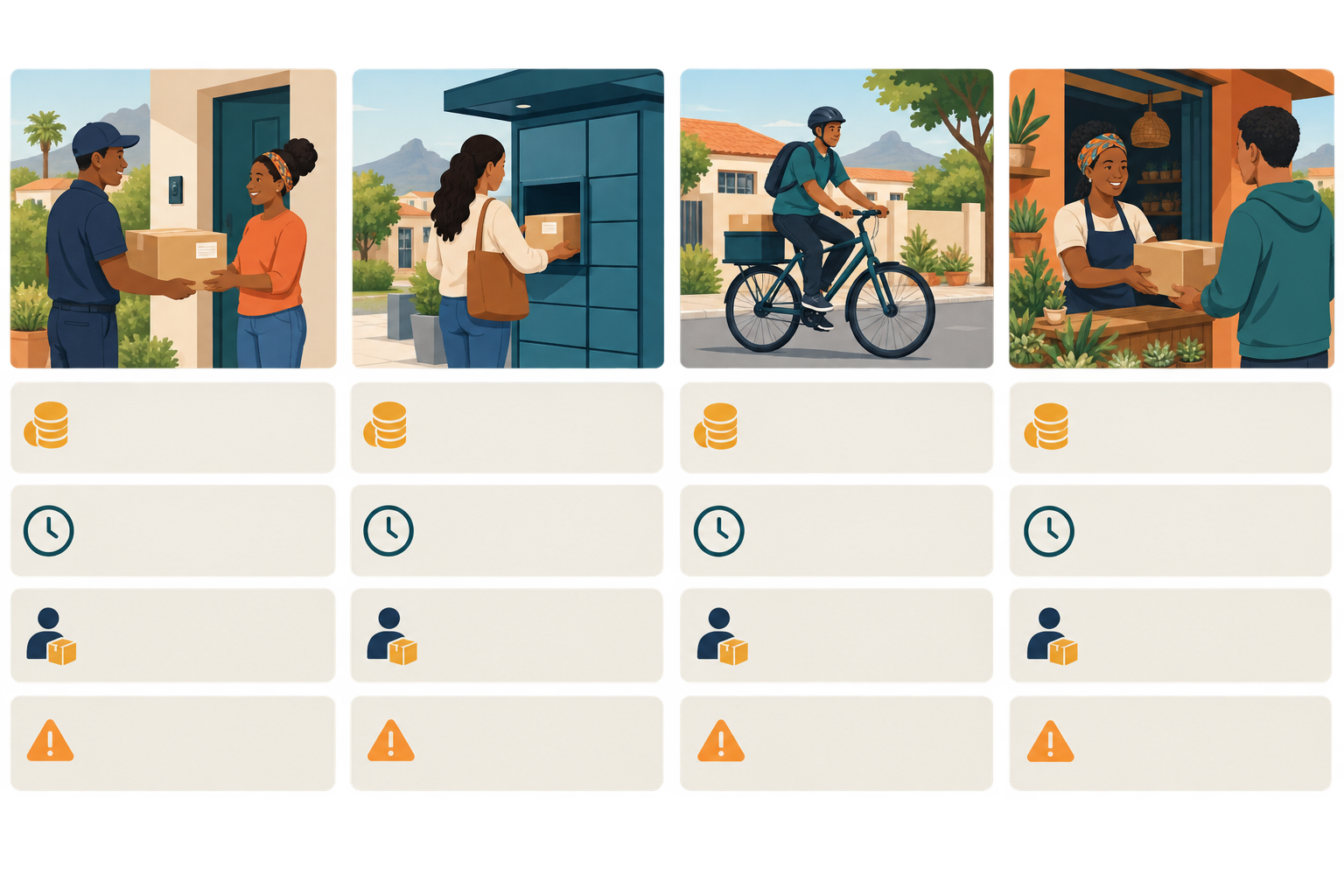
There's no single best option, only the best fit for your products and customers. Your main choices are door-to-door couriers (such as The Courier Guy or Aramex), pickup-point and locker networks (such as Pargo, PAXI or PUDO), the post office, delivering yourself, and customer collection.
Online retail in South Africa reached roughly R71 billion in 2023, up about 29% on the year before, according to World Wide Worx's annual online retail research. More people are buying online, and they want a clear idea of how and when their order will arrive.
Here's a side-by-side look. The rand ranges are illustrative planning estimates, not live quotes. They assume a small, light parcel (roughly a 30 × 20 × 10 cm box under 2 kg) travelling between major metros such as Johannesburg, Cape Town and Durban, and they leave out remote-area surcharges, insurance and special services. Rates vary by provider and change over time, so confirm against each provider's current rate page or quote tool before you set your prices.
| Option | Illustrative cost | Typical speed | Best for | Main drawback |
|---|---|---|---|---|
| Door-to-door courier | About R70 to R120 | Commonly advertised at 2 to 5 working days between major metros; longer to smaller towns | Reaching customers nationwide | Surcharges for remote areas; someone needs to receive it |
| Pickup point or locker | About R45 to R85 | Similar to courier, plus the customer's collection time | Customers out during the day, or who prefer not to share a home address | Size and weight limits; poor fit for bulky or fragile items |
| Post office | Depends entirely on the service chosen, so get a current quote | Varies by service | Light, low-value items | Tracking and reliability depend on the service |
| Your own local delivery | About R30 to R80 per drop, once you count time and fuel | Same day or scheduled days | Customers clustered in your suburb or city | Eats your time; hard to scale |
| Customer collection | R0 | Immediate, at agreed times | Local buyers | Needs a safe, organised handover |
How to compare courier quotes for shipping products
To compare fairly, quote the same parcel with every provider. Use your packed weight and dimensions from the cheat sheet and the same collection and delivery postcodes. Try one metro route, one small-town route and one rural route. Note whether each price includes VAT, fuel levies, insurance and collection from your door. Put the quotes in one spreadsheet with the date, and repeat every few months.
When are pickup points a good shipping option?
Pickup points can be cheaper, and they suit customers who aren't home during the day or don't want a parcel left at an unattended gate. They're a poor fit for bulky or fragile items, and for customers without a nearby point. Check each service's parcel-size and weight limits as well as the price, and make the collection location and any time limit clear at checkout.
Shipping to rural and outlying areas
Rural and outlying addresses often cost more and take longer. That's normal. It's perfectly fine to limit your delivery areas, or to say that remote destinations may carry an extra charge. Check that your courier actually serves the customer's address before you promise a date.
Local delivery and customer collection
Delivering yourself makes sense when your customers are concentrated, say around Sandton, Stellenbosch or Umhlanga, and your order volume is predictable. Set a clear delivery radius, fixed delivery days and a cut-off time. Then count the real cost in rand. If a round trip takes an hour and R40 of fuel, that's a cost per order, even if you never send an invoice for it.
Can customers collect from you? Yes, and it's a good low-cost option. Use a neutral collection point or set specific times, never publish your home address, and confirm the details with the customer after payment.
A quick POPIA note for customer delivery details
Under the Protection of Personal Information Act (POPIA), you have to handle customer details responsibly. Share only what a courier needs (name, delivery address and phone number), use it only for delivering that order, and keep it secure. Hold on to it only as long as you need it or the law requires, for example for tax and record-keeping. After that, delete or anonymise it. The Information Regulator (inforegulator.org.za) publishes guidance for small businesses.
How to calculate shipping costs in South Africa: flat rate, calculated or free?
There are three common models:
- Flat rate: one price for everyone. It's easy for customers and simple to set up, but it can undercharge for heavy or remote parcels and overcharge for small nearby ones.
- Calculated or tiered: priced by weight, size or region. This is more accurate, but it can make checkout feel complicated.
- Free shipping: either always, or above a spend threshold. It isn't free for you. The cost has to come from somewhere, usually your product prices.
Work out your real shipping cost per parcel
Add up the courier fee, packaging, label or printing, and your time, then compare that with what you charge. Don't forget payment fees. On Shopstar's Start Free plan, the all-in rate is 6% per sale (a 2.9% payment gateway fee plus a 3.1% Shopstar fee), so on a R400 sale that's R24 before shipping. On the Lower Fees plan, it's 2.9% per sale plus a monthly fee. Check Shopstar's pricing page for current terms, and build whatever applies to you into your pricing from day one.
Shipping cost example in rand
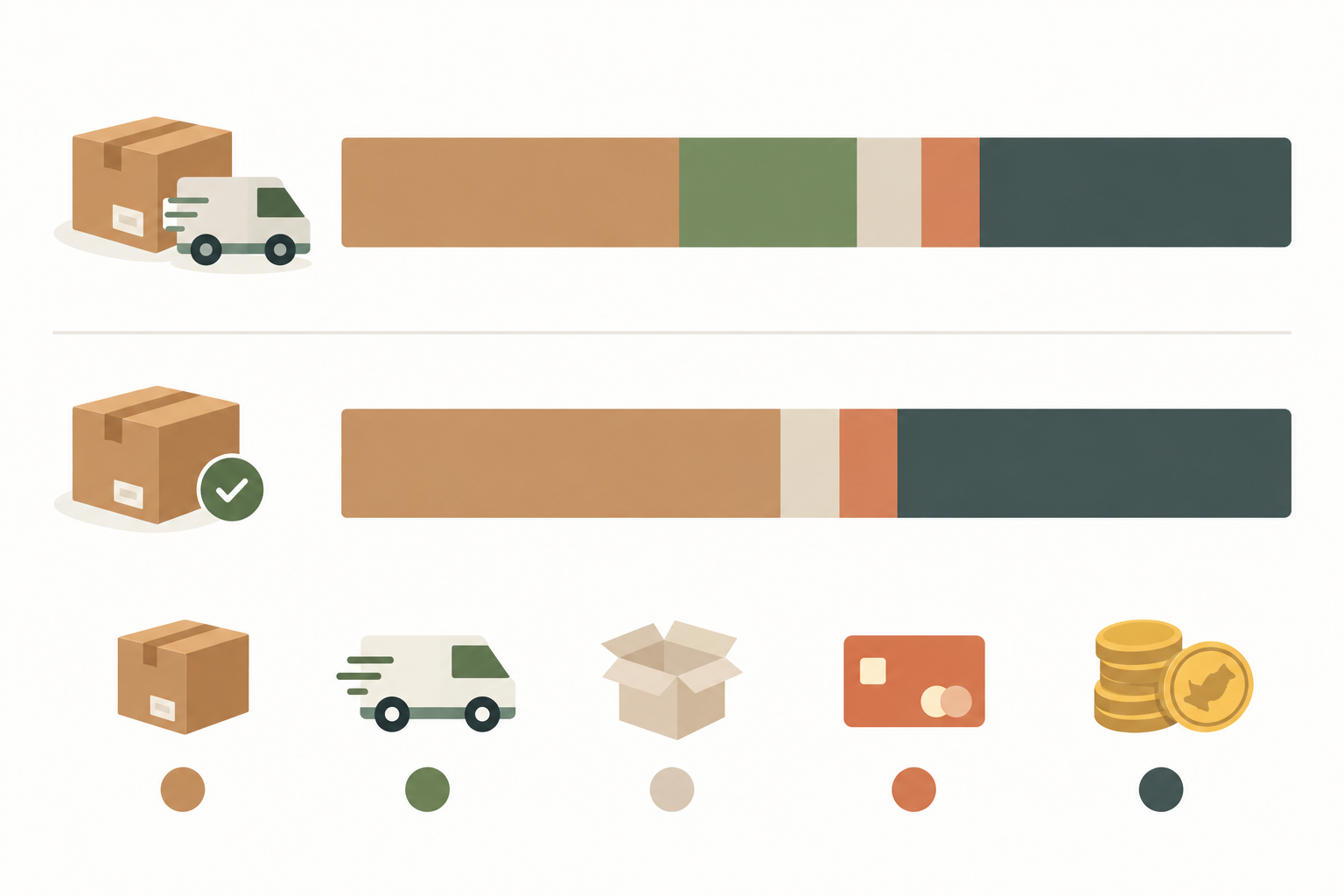
Say you sell a candle set for R350. It costs you R150 to make. The courier fee is R65 and packaging is R12. On the Start Free plan, the 6% fee on R350 is R21. (To keep things simple, this example ignores VAT and your own time.)
- If you give shipping away: R350 − R150 (product) − R65 (courier) − R12 (packaging) − R21 (fees) leaves you with R102.
- If you charge R65 for shipping: the customer pays R415, the fee is about R24.90 (assuming it applies to the full amount paid), and you keep roughly R163.
That R61 difference per order adds up fast. Over 50 orders in a month, it's over R3,000.
Should I offer free shipping as a small seller?
Only if your margin can handle it. It works well when you've built the cost into your prices, or as a threshold that lifts order value. For example, if your average order is R450, free shipping over R600 nudges customers to add one more item. It can hurt on heavy or low-margin products.
Here's a simple test. Run a threshold for a month, then compare your average order value and number of orders against the month before. If the average climbs and margins hold, keep it. If not, adjust.
Whichever model you choose, show the delivery charge and any conditions before checkout is complete, including whether remote areas may cost more. The Consumer Protection Act (CPA) expects clear, honest pricing, and customers appreciate it too.
A short VAT note on shipping charges
VAT in South Africa is 15%. If you're VAT registered (registration is compulsory once your taxable turnover passes R1 million in any 12-month period), VAT applies to shipping charges too, so price accordingly. Check the SARS website (sars.gov.za) for current rules, and speak to a registered accountant about your situation.
Packing products safely for delivery
Good packing is cheaper than replacing broken orders. Here's what I'd do:
- Match the packaging to the product. Bubble wrap or paper fill suits breakables, waterproof bags suit clothing, and rigid mailers suit flat items like prints.
- Do the shake test. Before sealing, give the box a gentle shake. If anything moves, add padding.
- Choose sturdy boxes over flimsy ones, and seal them with proper packing tape.
- Include a packing slip or thank-you note with your contact details. It makes returns and queries much easier.
- Brand on a budget. Stickers, tissue paper or a simple stamp make a plain box feel special without costing much.
- Photograph every packed order before it leaves. That photo is your proof if there's a damage claim.
- Avoid oversized boxes. They add volumetric weight, which means a higher courier bill.
Set realistic delivery time expectations
Your delivery promise has two parts: your handling time (how long you take to pack and hand the parcel over) and the courier's transit time. Customers need to hear about both.
Many small sellers dispatch within 1 to 2 working days, and couriers commonly advertise roughly 2 to 5 working days between major cities, with longer for remote areas. Treat those as starting points. Confirm them with your chosen courier, then check them against your own completed orders. If your real deliveries take a day longer than the courier's fastest advertised time, quote the longer one.
Plan for busy periods and public holidays
Black Friday and the December holidays strain every courier network, and load shedding can disrupt your packing, label printing and customer messages. Add a buffer in those weeks and tell customers early.
Tell customers when their order will arrive
Put shipping information on your product pages and at checkout, not buried in small print. A good example: 'Dispatch in 1 to 2 working days. Delivery typically takes 2 to 5 working days after dispatch. Remote areas may take longer.' Also state your order cut-off time and how weekends and public holidays are handled.
The legal side of delivery times
Section 19 of the CPA deals with delivery. In short, if you agree or state a delivery date, treat it as a commitment. If you miss it, the customer may have remedies, which can include cancelling the order and getting their money back. If no time was agreed, delivery should still happen within a reasonable time, and what's reasonable depends on the circumstances. The CPA also prohibits false or misleading statements about delivery. So promise only what you can actually do, and have a consumer-law specialist check your terms. The National Consumer Commission (thencc.org.za) publishes the Act and guidance.
Send tracking details as soon as the parcel is booked, and a quick message when it's dispatched. That alone heads off most 'where is my order?' messages.
What to do if a parcel goes missing, arrives late or is damaged
It will happen eventually, even to careful sellers. What matters is how you respond.
- Reply fast and kindly. If something's damaged, ask for a photo of the outer box, the label and the item.
- Check tracking and open a trace with the courier. Keep your waybill number, order number and proof of dispatch handy.
- Decide on a fix: reship, replace or refund. Don't make the customer chase you.
- Lodge a claim with the courier. Check their claim limits and deadlines up front. Declaring the value, and considering shipping insurance on higher-value items, can make claims smoother.

Who is responsible if a parcel goes missing?
As a general rule under the CPA, goods stay at the seller's risk until the customer actually takes delivery. A courier's tracking status saying 'delivered' isn't automatically proof that the customer received the parcel, and using a courier doesn't remove your obligations to the buyer. Be careful with terms in your policy that try to push transit risk onto the customer, because the CPA restricts unfair terms. Where goods are defective or don't meet the CPA's quality standards, the customer can generally choose repair, replacement or a refund within six months of delivery.
Returns and cooling-off periods for online orders
The Electronic Communications and Transactions Act (ECTA) gives online buyers a 7-day cooling-off period, counted from receiving the goods. The customer can cancel without giving a reason and without penalty, and you must refund them within 30 days of cancellation. The right does have exceptions, though. It generally doesn't apply to goods made to the customer's specification or clearly personalised, perishable or everyday-consumption foodstuffs, unsealed audio, video or software, newspapers and magazines, and certain services such as accommodation or event tickets for a specific date. Section 42 of ECTA has the full list.
On return costs: under ECTA, the customer generally carries the direct cost of returning goods when they use the cooling-off right, unless you said otherwise before they bought. If the goods were faulty or not as described, the cost is yours. Say clearly in your policy who pays for what.
Write a short, plain-language shipping and returns policy and put it on your page. If a dispute can't be resolved between you and the customer, the Consumer Goods and Services Ombud (cgso.org.za) is a possible next route, so acknowledge complaints quickly and keep a written record.
One bright spot: a good recovery often turns an annoyed customer into a loyal one. 💛
Set up shipping on your Shopstar page
Shopstar is an ecommerce platform and online store builder for sellers who don't want to build a full website. Here's how to set up shipping:
- Add your physical products with accurate weights and sizes, using the measurements from your cheat sheet.
- Set your shipping options: a flat rate, free over a threshold, local delivery or collection. Start with one. You can always add more.
- Show shipping info where customers will see it: in product descriptions, in a short policy section, and in your link in bio message for Instagram and TikTok shoppers.
If you're not technical, relax. Onboarding help and hands-on support are available. And your gentle next step is to ship a test order to yourself or a friend. Check the cost, the timing and how the packaging holds up before you launch.
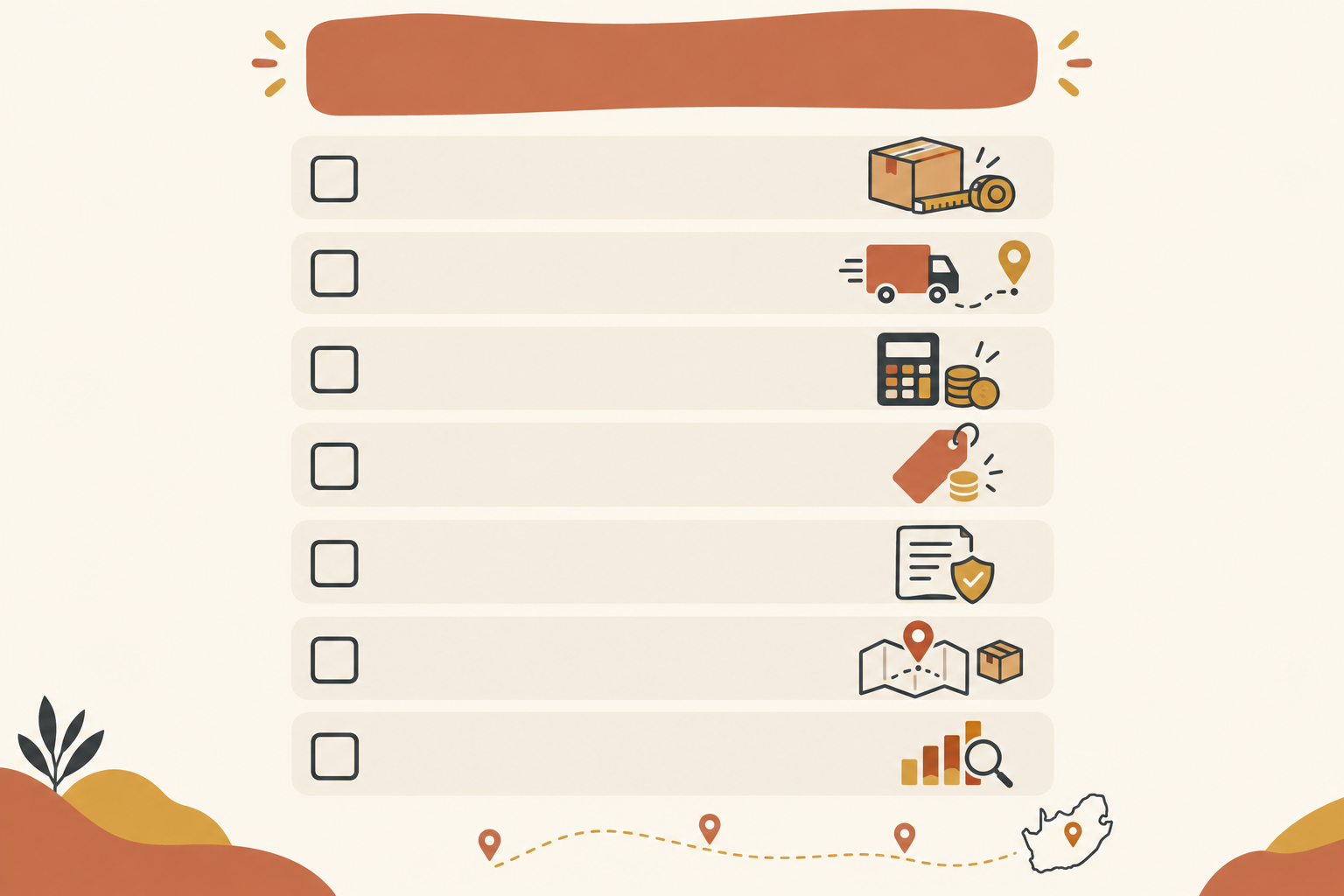
Small seller shipping checklist
- ☐ Measured and weighed every product with its packaging
- ☐ Chosen one or two delivery methods and one collection option
- ☐ Worked out the cost per parcel, including packaging and payment fees
- ☐ Decided on flat rate, calculated or a free shipping threshold
- ☐ Written a delivery time promise and a returns and lost parcel policy
- ☐ Set up tracking messages and a reliable packing routine
- ☐ Reviewed courier rates every few months, since prices change
Frequently asked questions about shipping products in South Africa
Should I offer free shipping as a small seller?
Only if your margin can handle it. A free shipping threshold, such as free delivery over R600, often works better than free shipping on every order. Work out your real cost per parcel first.
How do I work out shipping costs for my products?
Weigh and measure your packed parcel, get quotes for the same parcel from several providers, and add packaging and label costs. Then choose a flat rate, a tiered rate, or build the cost into your prices.
What if a parcel goes missing?
Contact the customer straight away, open a trace with the courier and offer a replacement or refund. Goods are generally at your risk until the customer takes delivery, so keep proof of dispatch and tracking numbers to back up your courier claim.
Can customers collect from me?
Yes. Use set collection times or a neutral collection point instead of your home address, and confirm the details after payment.
Do I need to charge VAT on shipping?
If you're registered for VAT, the shipping you charge is generally part of the sale and 15% VAT applies. Registration is compulsory once taxable turnover exceeds R1 million in 12 months. Check sars.gov.za or ask an accountant.
What personal information can I share with a courier?
Only what's needed to deliver, which is usually the customer's name, address and contact number. Under POPIA, use it only for that purpose, keep it secure, and delete it once you no longer need it or have to keep it by law.
Start simple, then refine your shipping process
Measure your parcels, compare quotes, price in rand, pack well, promise only what you can deliver, and write down your plan for when things go wrong. One clear delivery choice and an honest timeframe will take you a long way. Ship a test parcel, learn from it, and tweak as your orders grow. 🚀