How to Work Out Your Real Selling Fees as a South African Seller (With Worked Examples)
Compare ecommerce platform fees in South Africa, see how Shopstar’s free plan stacks up, and find the sales point where lower fees pay off.
13 min read
On this page
For sellers comparing ecommerce platform fees South Africa sellers need to budget for, the real selling fee is the payment gateway fee, plus the platform fee, plus any monthly subscription, spread across the sales you actually make. On Shopstar's Start Free plan that's a flat 6% all-in per sale (2.9% payment gateway plus 3.1% Shopstar fee) with no monthly fee. The Lower Fees plan drops to 2.9% per sale but adds a monthly fee. Which one suits you depends on your monthly sales, and I'll show you a one-line formula to find your break-even point.
Ecommerce platform fees South Africa sellers should compare: why the headline price is only half the story 💡
Here's the trap we see all the time. A platform shouts 'free!' or 'only R___ a month!' and you assume that's what selling online will cost. Then the first month's statement arrives with gateway fees, an app subscription for bookings, another for email, and a payout charge you didn't know about.
When people search for a free ecommerce platform in South Africa, they usually mean 'no monthly fee', not 'no cost to sell'. Even open-source tools with free core software can leave you paying for hosting, a domain, paid extensions, security and payment processing. Free to start is not the same as free to run.
That's why it's worth understanding ecommerce platform fees properly before you commit. By the end of this post you'll be able to work out your take-home profit on any sale in under a minute, and you'll know when it makes sense to pay a monthly fee to lower your per-sale cost.
A quick note from our team: during onboarding, the questions we hear most from new sellers are 'What will I actually keep?', 'Do I pay extra for bookings or digital downloads?' and 'When does the money hit my bank account?' Good questions, all of them. We'll answer each one below.
The three layers of ecommerce selling fees: gateway, platform and monthly
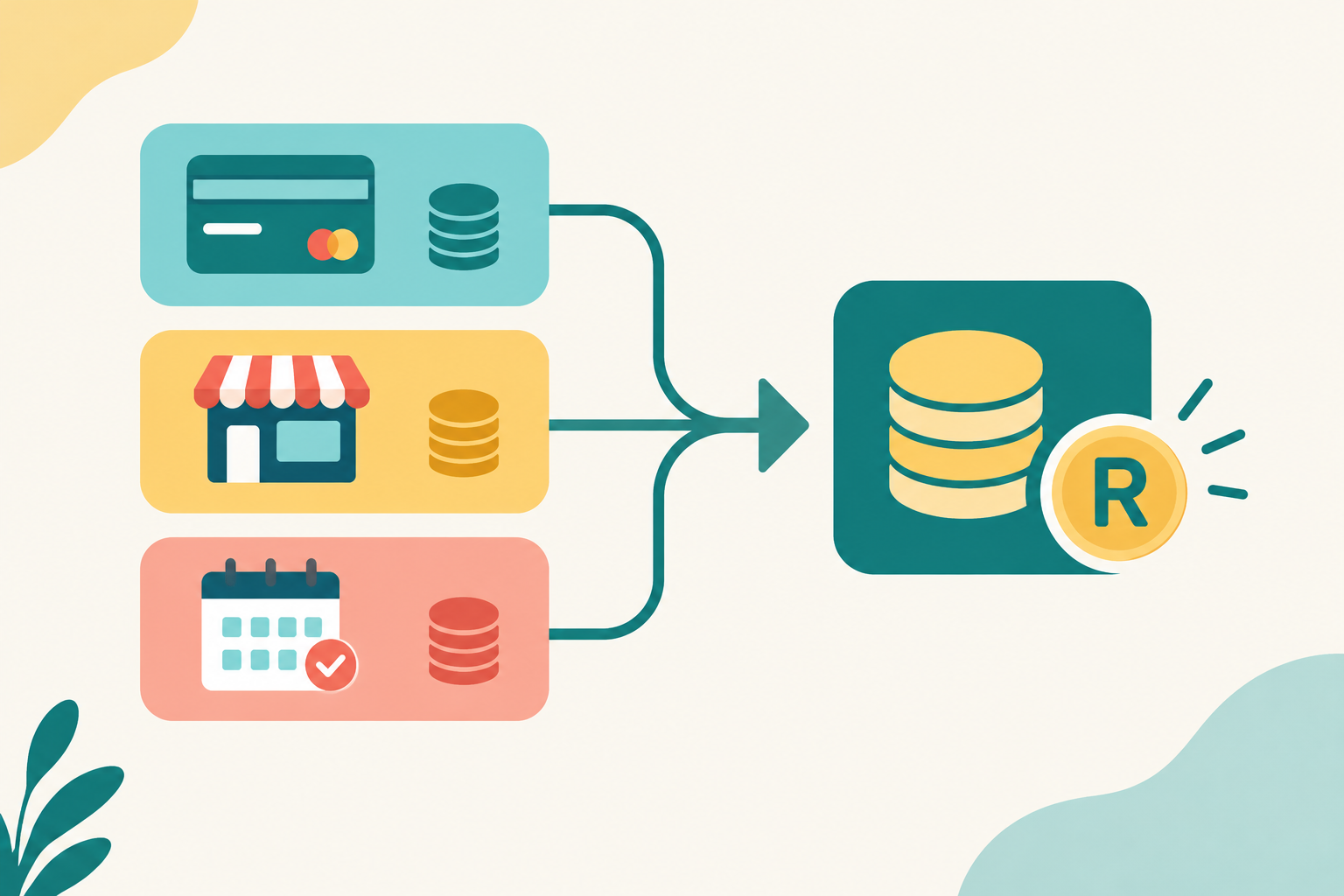
Every online sale carries up to three layers of cost. Once you can see them separately, comparing platforms gets much easier.
Layer 1: the payment gateway fee
This is the charge for securely processing the payment itself, whether it's a card, Apple Pay or Scan to Pay. It goes to the payment processor, not to the platform, and it applies to every transaction. On Shopstar it's 2.9%, handled through Shopstar Go.
Layer 2: the platform fee
This is what you pay for the store, the checkout and the tools that let you sell: your link in bio page, orders, products, customer data and support. On Start Free that's 3.1% per sale. Think of it as a fee for the software and service you're using, and you only pay it when you make a sale.
Layer 3: the monthly platform fee
This is the fixed cost that doesn't care whether you sell R0 or R50,000 that month. Start Free has none. Lower Fees has one, and in exchange the platform layer disappears, so you pay only the 2.9% gateway fee per sale.
What's the difference between a payment gateway fee and a platform fee?
The gateway fee pays for moving money safely from your customer's card or phone to you. The platform fee pays for the place where they shop and the tools you run your business with. Some platforms list them separately, and some stack extra transaction fees on top when you use an outside payment provider. Shopstar's Start Free plan bundles both into one 6% figure, so there's only one number to remember.
A word on VAT in South Africa
VAT in South Africa is 15%, and two things matter here:
- Check whether any quoted fee includes or excludes VAT. Whatever platform you compare, apply the same VAT treatment to each option, otherwise you're comparing apples with pears.
- VAT registration becomes compulsory once your taxable turnover passes R1 million in any 12-month period. Below that, registration is voluntary (with conditions). If you're registered, your selling prices should be VAT-inclusive, and it's worth chatting to your accountant about how VAT on fees is treated. SARS has clear guidance on its website.
What all-in ecommerce pricing means (and why it's easier to budget for)
All-in simply means the percentage you see is the percentage you pay. On Start Free, 6% covers the gateway and the platform together. There's no separate line for checkout, no extra fee for adding a product type and no monthly bill waiting at the end of a slow month.
That predictability suits small shops with uneven months. If you run a candle business, December might be wild and February very quiet. With no fixed fee, a quiet month costs you nothing extra, and you're never paying R300 for a store that sold R400 worth of stock.
Then there's the 'stitching' problem. Plenty of sellers end up with one tool for the shop, another for taking payments, a booking system for appointments, a separate service for event ticketing and something else again for a membership site. Each has its own fee, its own login and its own invoice. Shopstar runs physical products, digital downloads, bookings, memberships, subscriptions and event tickets through one unified checkout. Fewer tools means fewer fee layers, and fewer places for costs to hide.
How to calculate what you keep from every online sale
This is the part I promised: a repeatable sum you can do on your phone's calculator.
- Start with your selling price. If you're VAT registered, note whether that price includes the 15% VAT, and be consistent.
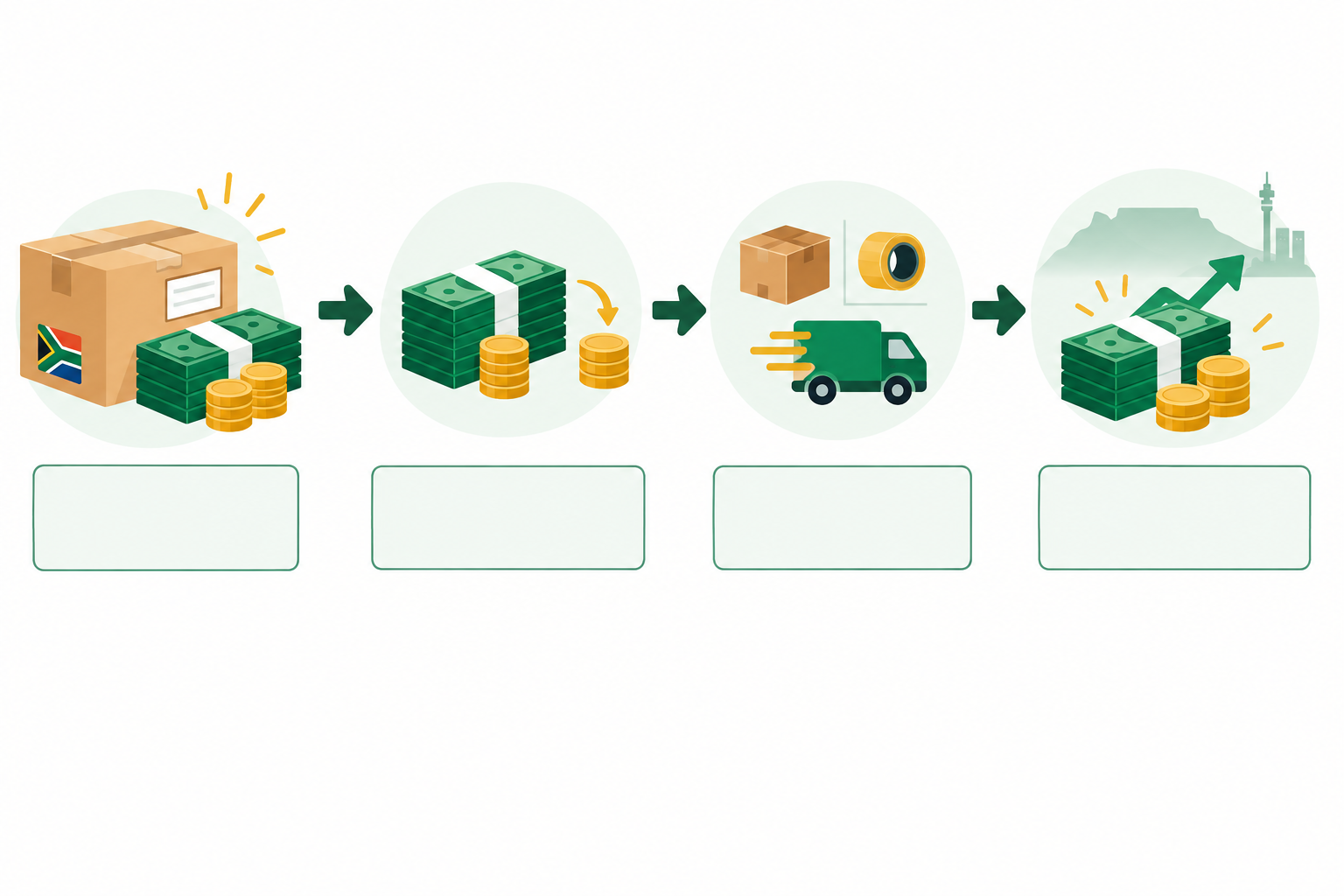
- Multiply by your per-sale fee. Use 6% (0.06) on Start Free or 2.9% (0.029) on Lower Fees. A R280 sale at 6% gives a fee of R16.80.
- Subtract the fee, then your costs. Take away the fee, then your cost of goods or the cost of delivering the service. If the candle costs R120 in wax, jar, wick, label and packaging, then R280 − R16.80 − R120 = R143.20 profit.
- Spread any monthly fee across your sales. Divide the monthly fee by the number of sales you make that month. A R300 fee over 40 sales adds R7.50 to each sale. Over 20 sales it adds R15.
- Turn it into a margin. Divide profit by price: R143.20 ÷ R280 = roughly 51%. A percentage lets you compare a R280 candle with a R95 wax melt fairly, instead of just looking at rand amounts.
My tip: put this into a simple spreadsheet with columns for price, fee percentage, fee in rand, product cost, profit and margin, then copy the row down for every product. It doubles as a record for SARS, because you're required to declare your income and keep proper records of your sales and expenses.
Ecommerce platform fee examples: a candle maker, a studio and a template creator 🕯️
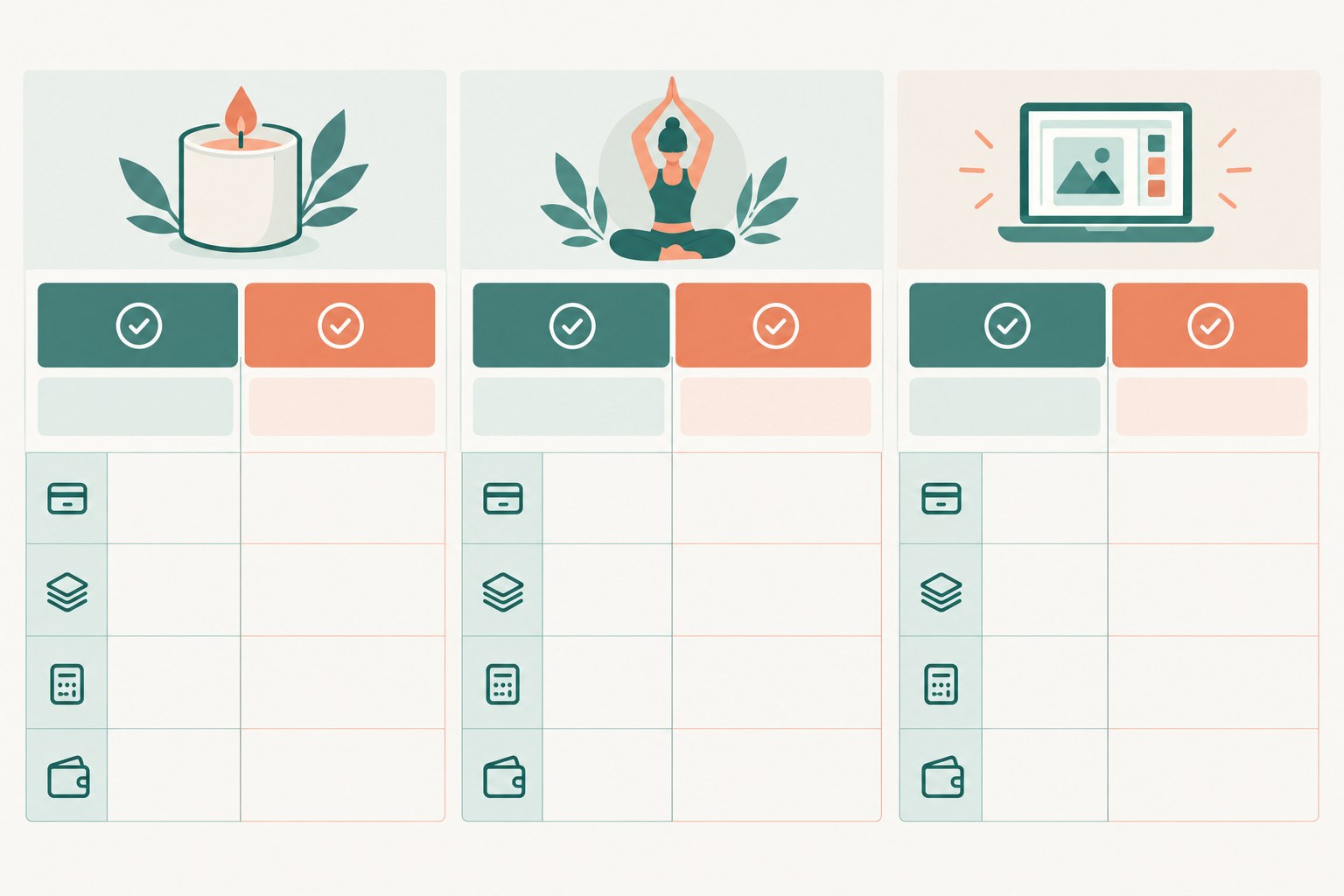
Let's put real rand amounts through the formula. The Lower Fees column shows the per-sale fee only, so it leaves out the monthly fee. We'll deal with that in the break-even section.
The candle maker in Stellenbosch
Thandi sells a R280 soy candle through her link in bio page. She assumed 'free plan' meant she'd keep the full R280. In reality:
| Start Free | Lower Fees | |
|---|---|---|
| Price | R280.00 | R280.00 |
| Gateway fee (2.9%) | R8.12 | R8.12 |
| Shopstar fee (3.1%) | R8.68 | R0.00 |
| Total fee | R16.80 | R8.12 |
| Amount kept | R263.20 | R271.88 |
She still has wax, jars and packaging to pay for, but now she knows her starting point.
The yoga studio in Woodstock, Cape Town
A studio sells a R150 drop-in class and a R1,200 monthly membership. Both run through the same checkout: the booking system takes the class reservation, and the membership site handles the recurring payment.
| R150 drop-in (Start Free) | R150 drop-in (Lower Fees) | R1,200 membership (Start Free) | R1,200 membership (Lower Fees) | |
|---|---|---|---|---|
| Gateway fee (2.9%) | R4.35 | R4.35 | R34.80 | R34.80 |
| Shopstar fee (3.1%) | R4.65 | R0.00 | R37.20 | R0.00 |
| Total fee | R9.00 | R4.35 | R72.00 | R34.80 |
| Amount kept | R141.00 | R145.65 | R1,128.00 | R1,165.20 |
The studio owner had been paying for a booking tool, a payment link and a membership plugin separately. Seeing one percentage on one dashboard was the real relief for her.
The template creator in Johannesburg
Lerato sells Notion and Canva templates at R350 each. Digital downloads have no stock and no shipping, so the fee is nearly the only cost.
| Start Free | Lower Fees | |
|---|---|---|
| Price | R350.00 | R350.00 |
| Gateway fee (2.9%) | R10.15 | R10.15 |
| Shopstar fee (3.1%) | R10.85 | R0.00 |
| Total fee | R21.00 | R10.15 |
| Amount kept | R329.00 | R339.85 |
This is where the fee percentage matters most. When your margin is already 90-plus percent, a few percentage points take a much bigger bite out of your real profit than they would for a candle maker with R120 in materials.
Start Free vs Lower Fees: find your break-even sales point
The logic is simple. Lower Fees saves you 3.1% on every sale (6% minus 2.9%), but you pay a monthly fee for that privilege. The question is how many sales it takes before the savings outweigh the fee.
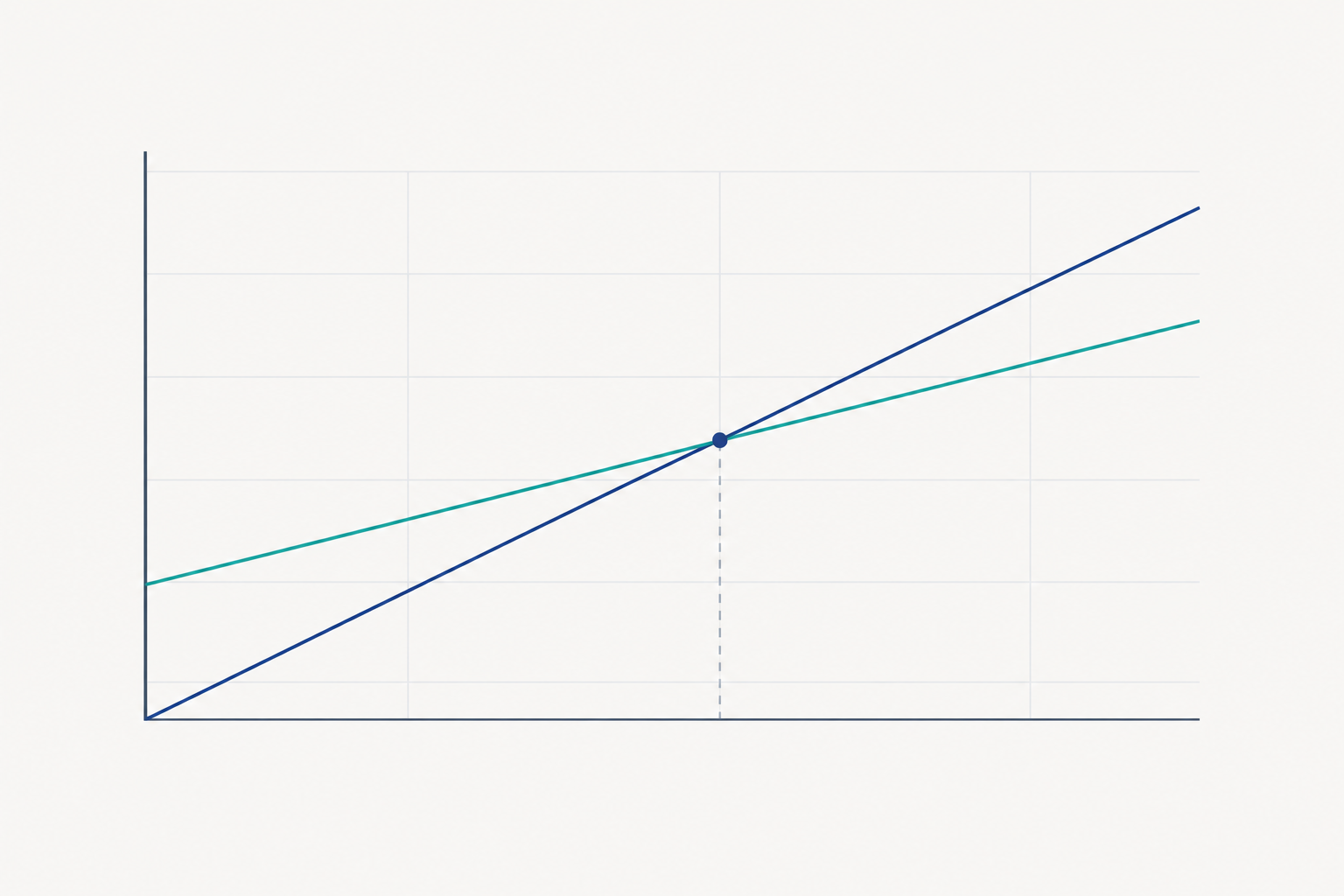
Here's the one-liner:
Break-even monthly sales = monthly fee ÷ 0.031
Let's walk through it:
- Find the current Lower Fees monthly price on Shopstar's pricing page. For this illustration I'm using a placeholder of R300 a month. Swap in the real figure before you decide anything.
- Do the sum. R300 ÷ 0.031 = roughly R9,677 in monthly sales.
- Check it. At R9,677 in sales, Start Free costs 6% = R580.62. Lower Fees costs R300 + 2.9% (R280.63) = R580.63. Same thing, give or take a cent.
- Translate it into real life. On that placeholder fee, break-even is about 35 candles at R280, about 65 drop-in classes at R150, or about 28 templates at R350 every month.
- Apply a rule of thumb. If you consistently sail past break-even for two or three months in a row, switch. If your sales are seasonal, or you're just starting out, Start Free keeps your risk at zero.
- Remember it isn't a one-time bet. You can start free and move up as you grow, so there's no need to guess your future sales on day one.
One caution: use sales that actually run through your store, not sales you hope to make. Refunds, discounts and seasonal dips all change the picture, so test a few different months before you decide.
Hidden ecommerce platform costs in South Africa: payouts, apps and add-ons
The fee on the pricing page is rarely the whole bill, on any platform. Here's what to look for when you compare ecommerce platform fees in South Africa.
- Payout timing and charges. Shopstar Go pays out automatically every day to your South African bank account. Ask every platform you consider how long you'll wait and what they charge. A payout delay can hurt your cash flow even when there's no fee attached.
- Paid apps and plugins. Bookings, ticketing, memberships and email tools often come as separate subscriptions. Three R150 add-ons quietly become R450 a month, and that belongs in your break-even sum.
- Extra transaction fees. Some platforms charge their own transaction fee on top of the payment provider's fee when you use an outside gateway. Others charge differently for different product types.
- Fixed per-transaction charges. A fixed fee of R2 sounds tiny, but it's 2% of a R100 order and just 0.2% of a R1,000 order. If you sell lower-priced items, calculate the fee against your typical order value, not an average month.
- Refunds and chargebacks. A refunded order doesn't always mean the processing fee comes back to you. Check the terms and record refunds separately in your spreadsheet.
- Costs outside the platform. Courier fees, packaging, bank charges, and a domain if you connect your own. These aren't platform fees, but they come out of the same margin.
- Compliance, which costs time more than money. The Consumer Protection Act (CPA) expects clear pricing and fair refund practices. The Electronic Communications and Transactions Act (ECTA) sets out requirements for online sellers, including cooling-off rights for many distance sales. POPIA governs how you collect and store customer data. And SARS expects you to declare your income. None of this is scary, but it's worth building into how you run your shop.
A quick checklist for comparing ecommerce platforms
- What is the monthly fee, and is VAT included?
- What is the gateway fee, percentage plus any fixed amount?
- Is there a separate platform or transaction fee on top?
- Which apps would I need, and what do they cost per month?
- Do bookings, tickets, memberships and digital downloads cost extra?
- How often do payouts arrive, and are there payout charges?
- Do I get hands-on help when I get stuck?
How to build ecommerce fees into your prices without scaring customers
The cleanest way to price is to work backwards from what you want to keep. The formula is:
Price = (cost + desired profit) ÷ (1 − fee rate)
Say you want to keep R200 from a product on Start Free's 6% fee. R200 ÷ 0.94 = R212.77, so a price of about R213 does the job. Rounding up to a clean R215 feels natural to a customer, and you keep R202.10 after the R12.90 fee. Compare that with slapping a visible 'card fee' surcharge on the checkout. Customers tend to hate it, and it's an easy way to lose a sale at the last step.
Under the CPA, the price you display should be the full price, with VAT included where it applies, and there should be no nasty surprises at checkout. Build the fee into your price from the start and the problem never comes up.
A few other levers help the percentage hurt less:
- Bundles: three candles at R780 instead of three separate R280 sales.
- Minimum order values, which are handy for low-priced items where fixed fees bite.
- Membership pricing: a R1,200 monthly membership is more predictable than ten R150 drop-ins.
- Booking packages: sell a 10-class pass instead of single sessions and your average order value rises.
Choose an ecommerce platform plan with confidence ✅
To recap: your real fee is the gateway fee plus the platform fee plus any monthly fee, spread over the sales you make. Multiply price by fee rate, subtract your costs, spread the monthly fee, and turn the result into a margin. To compare plans, divide the monthly fee by 0.031.
Take last month's sales and run them through the formula. It takes ten minutes, and you'll know more about your business than most sellers do. If you'd like to launch a link in bio page that works like an online store builder, with no monthly fee, Start Free is a low-risk place to begin, and our team will help you get set up. Shopstar stores have processed over R250 million in paid orders, and we hold a 4.9-star Google rating across 120+ reviews. We're proud of that, but we're even prouder when a seller tells us they finally understand their numbers.
Frequently asked questions about ecommerce platform fees in South Africa
How much does it really cost to sell online in South Africa?
It depends on your platform, but add up three things: the payment gateway fee, the platform fee and any monthly subscription. Then add extras like paid apps and courier costs. On Shopstar's Start Free plan it's 6% all-in per sale, so a R280 candle costs R16.80 in fees and you keep R263.20 before your own costs.
What is the difference between a payment gateway fee and a platform fee?
The gateway fee covers processing the card, Apple Pay or Scan to Pay payment securely (2.9% on Shopstar). The platform fee covers the store, checkout and tools that let you sell (3.1% on Start Free). Some platforms list them separately, while Shopstar's Start Free plan bundles them into one 6% figure.
Is a free plan with a higher per-sale fee better than a monthly plan?
It's better when your sales are low, new or unpredictable, because you only pay when you sell. Once your monthly sales are consistently above your break-even point, a plan with a lower per-sale fee and a monthly fee costs less overall.
At what sales level should I switch to a lower-fee plan?
Divide the monthly fee of the Lower Fees plan by 0.031 to find your break-even monthly sales. If you regularly exceed that number, switching saves you money. Check the current monthly fee on the Shopstar pricing page and run the sum with your own figures.
How do I factor ecommerce fees into my product or service prices?
Work backwards from the amount you want to keep: divide your cost plus desired profit by (1 minus your fee rate). On a 6% fee, you'd need to charge about R213 to keep R200. Then round to a clean, VAT-inclusive price if you're VAT registered.
When do I get my money after a customer pays?
With Shopstar Go, payouts are automatic and daily to your South African bank account. Check how long your own bank takes to reflect the payment, and compare payout timing when you look at other platforms.
Do I pay extra fees for digital downloads, bookings or tickets?
Shopstar's plans are priced per sale, and its unified checkout handles physical products, digital downloads, bookings, memberships and event tickets. Check the pricing page for the latest details, and watch for platforms that charge extra for separate booking or ticketing add-ons.