Early Bird Tickets: How to Price and Promote Your Event (A Practical South African Playbook)
Learn how to price early bird tickets in South Africa with practical discounts, ticket limits, deadlines and fees for workshops and small gigs.
14 min read

On this page
Disclosure: I'm part of the team at Shopstar, so I'm biased. Where I use Shopstar's fees as a worked example, they're the fees at the time of writing. Fees can change, so check current pricing before you rely on them. The pricing method works with any ticketing tool, and you can swap in your own provider's rate.
If you only remember one thing from this post, make it this: for most workshops and small gigs, a good starting point for early bird tickets is a 15-25% discount on about 20-30% of your capacity, with a clear deadline 3-4 weeks before the event. Set your standard price first and build your payment fees into it so you don't undercharge. Then announce the deadline loudly and stick to it.
The rest of this post is the practical detail: how to pick the numbers, where to put the deadline, how to tell people about it, and how to check that you're still taking home enough per seat. All the examples are in rand. Most pricing advice online is written in dollars, and that doesn't help much when you're booking a venue in Observatory or Melville.
A quick honesty note: the percentages and timings below are rules of thumb from what I've seen work for small organisers, not results from a controlled study. Treat them as a starting point and adjust once you see how your own audience behaves.
Why early bird ticket pricing works (and when it doesn't) 🐦
Early bird pricing gets you two things most small organisers badly need: cash and commitment, early. Once people have paid, the event feels real. That helps you decide whether to go ahead, and it helps your buyers too, because they've now put a date in their diary.
The psychology is simple. A deadline gives people a reason to decide now instead of 'sometime'. Without one, 'I'll book later' quietly turns into 'I forgot'. Early buyers also tend to pitch up more reliably, because they've already paid and don't want to waste it.
The practical wins for a small organiser are real:
- Early cash to cover a venue deposit, the caterer or your facilitator
- Early proof of demand, so you know whether to push harder or adjust
- A built-in reason to market in week one, because 'early bird closes on the 18th' is a much stronger message than 'tickets available'
Picture a Saturday pottery workshop in Cape Town with 40 seats. The host announces early bird tickets with a firm closing date and sells 12 seats in the first week. That's 30% of the room filled before she's spent a rand on ads, and she can pay the studio deposit without losing sleep.
It doesn't always work, though. If your event has only 10-15 seats, or it tends to sell out the moment you announce it, you may not need a discount at all. A simple 'first 10 seats at R300, then R350' might do the job better, and it protects your margin. Discounts are a tool for filling seats, not a ritual.
How much should you discount early bird tickets?
My rule of thumb is 15-25% off the standard price for workshops and small gigs. In my experience, anything under 10% is often too small to get anyone moving. Once you go past 30%, you risk teaching your audience to wait for deals, and you give away money you probably need. Your audience may behave differently, so note what happens and adjust next time.
Here's a worked example. Say your standard ticket is R350 and your early bird is R280 (20% off). That's a R70 gap per ticket. If all 40 seats sold at the early bird price, you'd give up R2,800 compared with selling them at standard. Selling only 12 at early bird costs you R840, which is a much easier trade for getting a third of the room filled early.
Here's how three discount levels compare:
| Discount | Early bird price | What the buyer might feel | Risk to your margin |
|---|---|---|---|
| 10% off | R315 | 'Nice, but I can wait' | Low, but may not move anyone |
| 20% off | R280 | 'That's a proper saving, I'll book now' | Moderate and easy to manage with a cap |
| 30% off | R245 | 'Great deal, but I'll wait for the next one' | High, and may train people to expect discounts |
Add value instead of cutting the ticket price
If you'd rather protect your headline price, add value instead of discounting. Early buyers could get a free workbook (a simple digital download works well), a drink on arrival or a recording of the session. These usually cost you very little but feel generous.
Show the early bird ticket saving
Here's a small framing tip: show the standard price crossed out next to the early bird price, like R350 R280. People see the saving at a glance without doing any maths.
A note on VAT for event tickets
VAT registration with SARS is compulsory once your taxable turnover passes R1 million in a 12-month period. If you're registered, the price you display should be the VAT-inclusive price, so what people see is what they pay. Don't add 15% on top at checkout. The VAT inside a R350 ticket is 15/115 of the price, which is R45.65, and that money is owed to SARS rather than kept by you. If you're below the threshold and not registered, you don't charge VAT at all. I'll show both versions in the fees section further down.
Setting early bird ticket tiers and limits: how many seats, and should you add VIP?
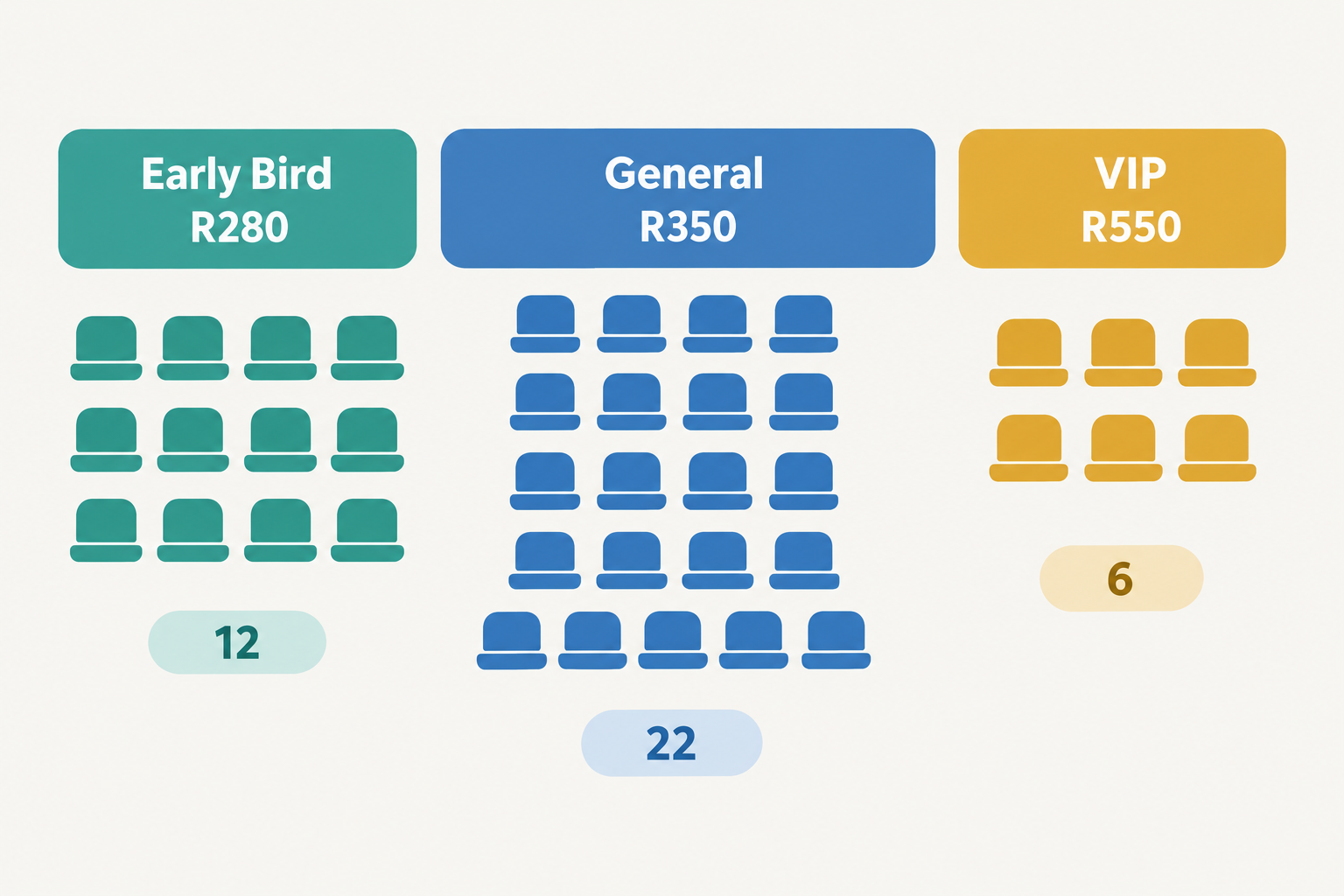
How many tickets should be early bird? Roughly 20-30% of your capacity. For a 40-seat workshop, that's 8-12 seats. Here's one way to split it:
- 12 seats at Early Bird (R280)
- 22 seats at General (R350)
- 6 seats at VIP (R550)
Why a hard cap beats an open window
A hard cap is honest and motivating. 'Only 12 early bird seats' gives people a real reason to move, as long as it's real. If you say 12 and then quietly sell 25, people will notice, and they'll stop trusting your deadlines.
Should you add a VIP ticket tier?
Yes, if you can offer something that costs you little but feels valuable, like front-row seating, a quick meet-and-greet, a printed takeaway or a take-home product from the workshop. A VIP ticket at R550 can sit nicely next to R280 and R350.
No, if it just complicates a small event. Three tiers is plenty. Every extra option adds questions in your DMs, and you'll end up spending more time explaining tickets than selling them. For very small events, early bird and standard are often enough.
Setting up early bird ticket types
Whatever tool you use, look for one that lets you create separate ticket types, each with its own quantity. That way early bird closes automatically when it sells out, and you don't have to watch the numbers or edit anything at midnight. It also beats juggling spreadsheets and EFT proofs of payment. On Shopstar, you do this on a link in bio page with event ticketing, alongside anything else you sell, but the principle is the same elsewhere.
A quick POPIA reminder
If you collect names, emails or dietary needs at checkout, you're handling personal information under POPIA. Only ask for what you genuinely need, and say why. 'We ask about allergies so the caterer can plan' is perfectly clear.
Timing early bird ticket price changes: when should the deadline be?
For most small events, a window of 2-4 weeks works well, ending at least 3-4 weeks before the event date. That's long enough for word to spread and short enough that the deadline still feels urgent.
Here's how I'd plan it, step by step:
- Work backwards from your event date. Choose your early bird closing date first, because everything else hangs off it.
- Launch 6-8 weeks out for workshops, or 8-10 weeks out for bigger gigs and events where people travel or need to arrange leave.
- Plan two nudges: one mid-window reminder and one 'last 48 hours' reminder. Put them in your calendar now, not when you remember.
- Decide what happens next. The standard price kicks in after the deadline, and if you like, you can add a final-week price for late buyers.
An early bird ticket timeline example
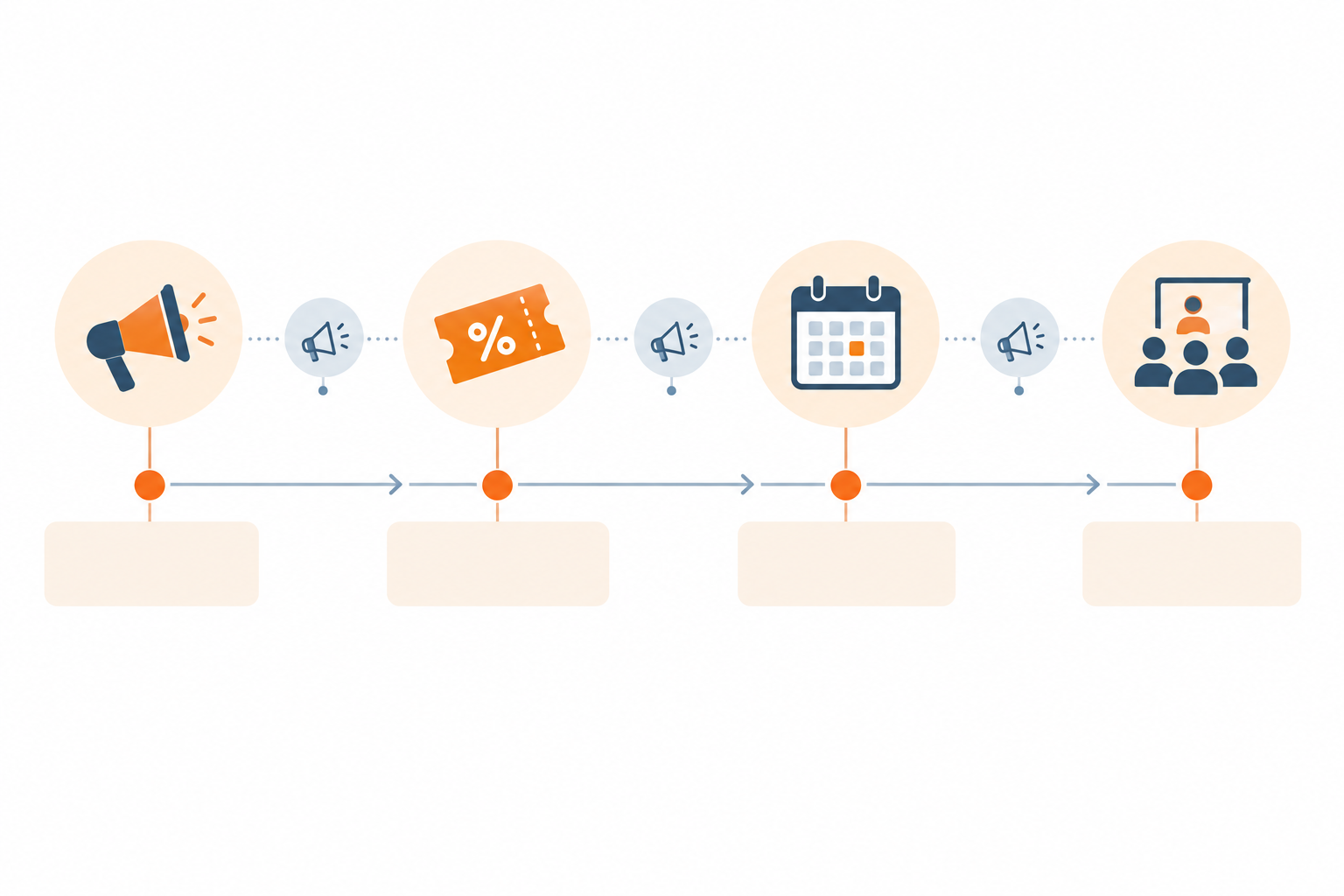
Say your workshop is on 14 June:
- 20 April: announce and open early bird tickets
- 4 May: halfway reminder
- 16 May: 'last 48 hours' reminder
- 18 May: early bird closes
- 19 May to 7 June: standard price
- 8-14 June: optional final-week push
South African timing notes
A few local realities are worth planning around:
- Month-end cash crunches: if you can, avoid launching right when everyone's wallet is empty.
- Payday, around the 25th: a reminder landing just after payday often does better than one just before.
- School holidays and long weekends: people are away or busy, and your messages get buried.
- Load-shedding: for evening events, check the schedule and think about whether your venue has backup power, because buyers will ask.
Don't keep moving the early bird deadline
If sales are slow, resist the urge to extend. Every extension teaches your audience that deadlines aren't real, and next time they'll wait. Send a reminder, add a small bonus or tell people why you're hosting the event. That works better than moving the goalposts.
How to promote early bird tickets and announce the deadline 📣
You don't need a big marketing budget. You need a clear message in the right places, starting with the people who already like you.
Start with your warmest audience
Your email list, WhatsApp broadcast or community, and past attendees should hear first. Give them first access, even a day early. They're your most likely early buyers, and they'll make the event look popular to everyone who arrives later.
Use the channels you already have
For most small organisers, a simple plan looks like this:
- Instagram: a link in bio plus a Stories countdown to the deadline
- WhatsApp: status updates and posts in the groups you're already part of
- Facebook: local community pages and event groups
- Partners: your venue's newsletter, a local business or a collaborator's mailing list
Share one clear booking link
Send everyone to a single page where they can see the event details, choose a ticket and pay in one checkout. The fewer steps between 'I'm interested' and 'I've paid', the more seats you fill. I'd always rather send one link than three.
Three early bird ticket promotion templates
Copy and adapt these. Each one has the exact price and the exact closing date and time:
- Announcement: 'Early bird tickets are open! Our pottery workshop in Cape Town is on 14 June. Early bird is R280 until 18 May at 20:00, then it goes up to R350. Only 12 early bird seats. Book here: [link]'
- Halfway reminder: 'Halfway through early bird! 5 seats left at R280. Closes 18 May at 20:00. [link]'
- Last 48 hours: 'Last 48 hours: early bird (R280) ends on 18 May at 20:00. After that it's R350. [link]'
Be clear about the ticket price
State the total price clearly, with no surprise add-ons at checkout. The Consumer Protection Act (CPA) expects clear, honest pricing and marketing, and displayed prices should include taxes. Legal side aside, surprises at the last step are the quickest way to lose a buyer.
Turn early buyers into promoters
Ask early buyers to share the event, and give them a small perk for bringing a friend, like a free tea or a discounted add-on. People trust friends more than posters.
When the early bird deadline hits
Close it on time. Thank your early buyers publicly (a Stories shout-out works), and switch the message to 'standard tickets now open'. That tells everyone you meant it.
How to price early bird tickets around fees (so you don't undercharge) 💰
This is where many first-time organisers get caught. They pick a price they like, discount it, and only later realise how little is left after fees, VAT and costs.
So how do you avoid undercharging? Work out what you need to take home per seat, then price up from there, instead of discounting down from a number you like.
The assumptions behind my examples
To keep the sums readable, every example below assumes:
- You're not VAT-registered, unless a section says otherwise.
- The payment fee is charged on the full ticket price the buyer pays. Check how your own provider applies fees, and whether any VAT applies to the fees themselves.
- There are no refunds, complimentary tickets or extra event costs beyond those I state.
- Figures are illustrations, not tax or accounting advice.
Example: Shopstar's fees
Shopstar has two plans. These are the fees at the time of writing, so please check current pricing:
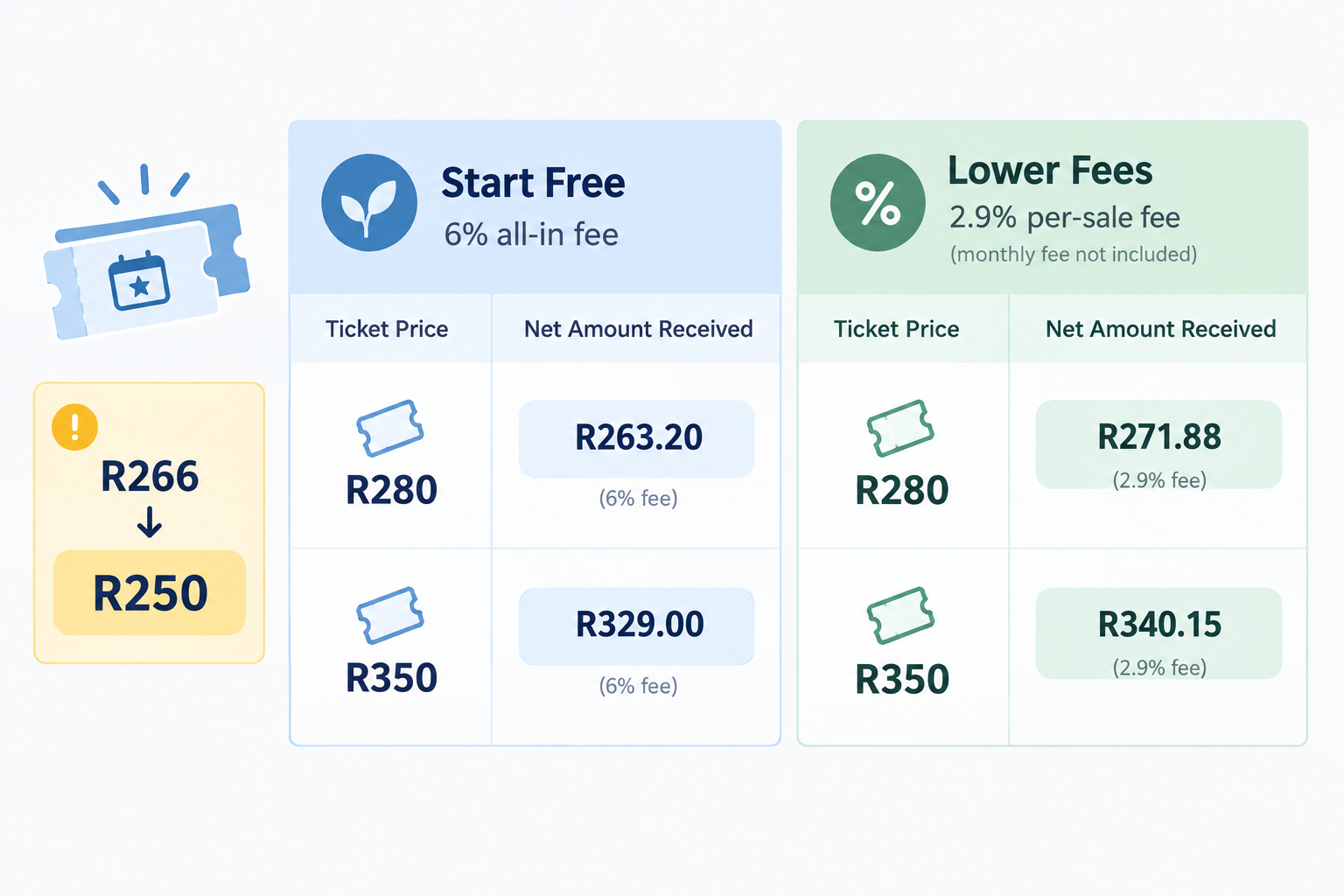
- Start Free: no monthly fee, and 6% all-in per sale (a 2.9% payment gateway fee plus a 3.1% Shopstar fee)
- Lower Fees: a monthly fee, and 2.9% per sale
Payments run through Shopstar Go (card, Apple Pay and Scan to Pay), with automatic daily payouts to your South African bank account. That daily payout is handy when a venue wants its deposit by Friday. If you use a different provider, just swap in its percentage in the sums below.
What you actually keep from each ticket
Here's what you'd take home per ticket, for a seller who isn't VAT-registered, before your event costs:
| Ticket | Start Free (6%) fee | You keep | Lower Fees (2.9%) fee | You keep |
|---|---|---|---|---|
| Early bird R280 | R16.80 | R263.20 | R8.12 | R271.88 |
| Standard R350 | R21.00 | R329.00 | R10.15 | R339.85 |
The Lower Fees figures don't include the monthly fee.
The reverse calculation for your ticket price
Say you want to keep R250 per seat, and you're not VAT-registered. On Start Free, divide R250 by 0.94 and you get about R266. On the Lower Fees plan, divide by 0.971 and you get about R258, before the monthly fee. It's a two-second sum that stops you pricing at R250 and keeping R235.
If you are VAT-registered, the VAT inside your price isn't yours to keep either. On Start Free with a VAT-inclusive price, you keep roughly 0.94 minus 0.1304 (that's 15/115) of the ticket price, which is about 81%. To keep R250 per seat, divide by 0.8096 and you get about R309. As a check, on a R350 ticket you'd pay R21.00 in fees and R45.65 in VAT, leaving R283.35. On a R280 ticket, you'd pay R16.80 and R36.52, leaving R226.68. Please confirm the details with your accountant or SARS, because fees and input VAT can complicate this.
Break-even example for a 40-seat event
Let's say your fixed costs are R3,000 for the venue and R2,500 for the facilitator, so R5,500, plus R60 per seat for materials. This is a simplified illustration for a non-VAT-registered seller on Start Free. It leaves out refunds, complimentary tickets, marketing spend and income tax.
- Each early bird seat leaves R263.20 less R60, which is R203.20.
- Each standard seat leaves R329 less R60, which is R269.
- 12 early bird seats bring in R2,438.40, leaving R3,061.60 of fixed costs to cover.
- At R269 each, that takes 12 standard seats to break even, so about 24 of your 40 seats.
Under these simple assumptions, the remaining 16 seats are where you start to earn, before tax. It also shows why a cap on early bird matters.
Want to compare plans? Take the full split from earlier (12 early bird, 22 standard, 6 VIP at R550, so R14,360 in total). Start Free would cost about R861.60 in fees, and Lower Fees about R416.44. That's a difference of roughly R445. If the Lower Fees monthly charge (which I haven't included) is less than that, Lower Fees comes out ahead for that event.
Which ticketing plan suits you?
Start Free suits occasional events and testing demand, because there's no monthly cost if you run one workshop a quarter. Lower Fees can make sense if you run regular events or sell high ticket volumes, because the per-sale rate is lower.
Don't forget the budget extras
Factor in complimentary tickets for staff, sponsors or your facilitator's guests. They bring in no revenue but may still add to venue and catering costs. And run your numbers for a slow-sales scenario before you publish, not after.
Tax and refunds
Your event income is still taxable income with SARS, so keep records of ticket sales, fees and costs. On refunds, set out your refund and transfer policy up front. Electronic sales fall under ECTA, and certain leisure services booked for a set date are generally treated differently when it comes to cooling-off rights. Even so, being clear is the best protection, and it's worth checking the specifics for your situation.
Early bird ticket pre-publish checklist ✅
- Calculate your costs per seat and the take-home amount you need after fees (and VAT, if registered).
- Set your standard price first, then your early bird price (15-25% below).
- Set your early bird cap (20-30% of seats) and your closing date.
- Decide whether a VIP tier adds real value or just complexity.
- Set up each ticket type with its quantity and the event details.
- Write your three announcement messages in advance and schedule them.
- Check that your pricing displays clearly, with VAT included if you're registered, and that your refund policy is visible.
- Go easy on yourself. Your first early bird run doesn't have to be perfect, and the numbers from this event will make the next one much easier to price.
Frequently asked questions about early bird tickets
How long should the early bird window run?
Two to four weeks works well for most workshops and small gigs. Close it at least 3-4 weeks before the event so you have time to promote standard tickets.
How many tickets should be early bird?
Around 20-30% of capacity, so 8-12 seats for a 40-seat workshop. That rewards early buyers without giving away too much margin.
Should I add a VIP tier?
Only if it offers something special that's easy to deliver, like priority seating or a take-home item. For very small events, early bird and standard are often enough.
How do I avoid undercharging on early bird tickets?
Start with the amount you need to keep per seat, then divide by what's left after fees (and VAT, if you're registered). For example, on a 6% all-in fee and no VAT, a R266 ticket leaves about R250.
Should I extend the early bird deadline if sales are slow?
Try not to. Extensions teach your audience that deadlines are flexible. Send a reminder, add a small bonus or share why you're hosting the event instead.
Can I sell early bird tickets without a full website?
Yes. A link-in-bio page with event ticketing lets you list multiple ticket types, set quantities and accept payments without building a site. That's what we built Shopstar to do for South African sellers, but any tool with separate ticket types and quantity limits will support the approach in this post.