How to Turn Your Skills Into Digital Products You Can Sell in South Africa
Turn your skills into digital products in South Africa: find a sellable idea, choose a simple digital download, and launch with an online store builder.
14 min read
On this page
You already know things other people would happily pay to learn, or to skip the hard work of figuring out. The simplest way to turn your skills into digital products is to start with a problem you've already solved for someone else. Package the answer in the smallest format that works (a template, checklist or short guide) and launch a first version for around R99 to R299. Real buyers will then tell you what to improve.
You don't need a full website or a big audience. You need a clear promise and a place to sell, like a link-in-bio store that takes payment and delivers the file automatically. The rest of this guide walks through how, step by step. 🚀
What Can You Sell Online? Start With Skills You've Already Used
Picture a Joburg bookkeeper who has explained the same invoicing basics to freelancers in her DMs for three years. Or a Durban wedding planner who sends every couple the same supplier checklist, rebuilt from scratch each time. Or a Cape Town teacher who keeps making revision worksheets for parents who ask nicely on WhatsApp. None of them think of themselves as having a product. But each of them has one sitting in their camera roll or Google Drive.
Here's the mindset shift: a sellable skill doesn't mean being a world-leading expert. It means being a few steps ahead of someone with a specific problem. Think of your product as a shortcut that saves someone time, money or confusion. It doesn't have to be a lecture.
What the numbers do (and don't) tell us
DataReportal's Digital 2024: South Africa report estimated about 45.34 million internet users at the start of 2024. World Wide Worx's online retail research put South African online retail at roughly R71 billion in 2023, up 29% year on year. Both figures describe online shopping as a whole, not digital downloads specifically, so they don't prove anyone will buy your idea. What they do tell us is that your potential buyers are online and used to paying there. Demand for your product is something you test yourself, and Step 1 shows you how.
Here's the plan we'll walk through:
- Identify skills people would pay for
- Choose the right format
- Build a minimum viable product
- Set up your sales page and start selling
- Gather feedback and improve
One honest expectation up front: your first product is an experiment, not an overnight income stream. Treat it as a small, low-risk way to learn what people want. It's a much more relaxing way to start.
Step 1: Turn Skills Into Digital Products People Need
This is where most people get stuck, so let's make it concrete.
- Run a skills audit. Grab a notebook and list your job skills, your hobbies, the things friends ask you for help with, and problems you've solved in the last two years. Don't judge anything yet.
- Use the 'ask, show, repeat' test. What do people ask you about? What do you show them how to do? What do you keep repeating? Anything that appears in all three columns is a strong candidate.
- Look for demand signals. Scroll Facebook groups, WhatsApp communities, Reddit threads and the comments on your own posts. Repeated questions like 'does anyone have a template for...' are gold.
- Check for South African relevance. Local context is often your edge. Think small-business admin for SARS, CAPS-aligned worksheets, load-shedding-proof meal plans, or event planning that understands local venues and suppliers. Generic international products already exist, but ones that fit here are rarer.
- Score each idea on three questions. Is the problem painful? Is it specific? Can I solve it in a single download? Ideas that score three out of three go on your shortlist.
- Do the gut-check. Ask yourself: would 5 people I know pay R150 for this? If you can name them, you're onto something. If you can't, narrow the audience or sharpen the problem.

Specific beats broad every time. 'I know Excel' is hard to sell. 'A pricing spreadsheet for freelance designers' is easy to picture. Here are a few examples to test (treat them as hypotheses, not guarantees):
- A bookkeeper turns client questions into a cash-flow or invoicing spreadsheet for South African freelancers.
- A teacher packages revision worksheets and offers a free sample page to parents first.
- A designer converts a frequently requested social media layout into editable templates.
A worked example: from repeated question to first offer
Let's follow one idea all the way through. Say Naledi is a Pretoria bookkeeper. Every month, three or four freelancers ask her the same thing: 'How much should I be setting aside for tax?'
- The problem: freelancers don't know what to save for SARS, so they get a nasty surprise at assessment time.
- The smallest solution: a simple spreadsheet where they enter monthly income and expenses and see a suggested amount to set aside, plus a one-page 'how to use this' guide.
- The promise: 'After this, you'll know what to put aside each month in under 10 minutes.'
- The starting price: R149. It's well below an hour of her consulting time and easy for a freelancer to say yes to, and she treats it as a hypothesis.
- The test: she sends it free to three clients for feedback and fixes the confusing bits. Then she shares it in two freelancer Facebook groups and her Instagram bio.
None of that needed a website, a course platform or a huge audience. It needed one real problem and a weekend.
How do I know if my skill is sellable?
Look for a specific problem that people already ask you about or complain about online, and that you can solve with a clear result. If you can describe who it's for and what they'll be able to do afterwards, and 5 people in your network would pay R100 to R200 for it, you have a strong starting point.
Do I need to be an expert?
Honestly, you need real experience and accuracy, not a qualification. If you've done the thing and got results, you can help someone who hasn't. But be clear about what you are and aren't. A bookkeeper can share a budgeting template without pretending to give personalised financial or legal advice. Say what the product does, and what it doesn't.
Step 2: Choose the Right Format for Your First Digital Product
Once you know the problem, pick the container. The rule of thumb is simple: match the format to the result the buyer wants. If they want to do something fast, give them a template. If they want to understand something, give them a guide. If they want to learn a whole skill, that's a course, and a bigger build.
| Format | Effort | Typical price | Best for |
|---|---|---|---|
| Checklists and planners | Low | R49 to R149 | Repeatable processes, event or admin routines |
| Printable or worksheet packs | Low to medium | R59 to R199 | Teachers, tutors, coaches |
| Templates and spreadsheets | Low to medium | R79 to R249 | Bookkeepers, designers, project managers |
| Short ebooks and guides | Medium | R99 to R299 | Anyone with step-by-step know-how |
| Presets and design assets | Medium | R99 to R349 | Photographers, designers |
| Recorded workshops or mini-courses | High | R299 to R999 | Skills easier to show than explain |
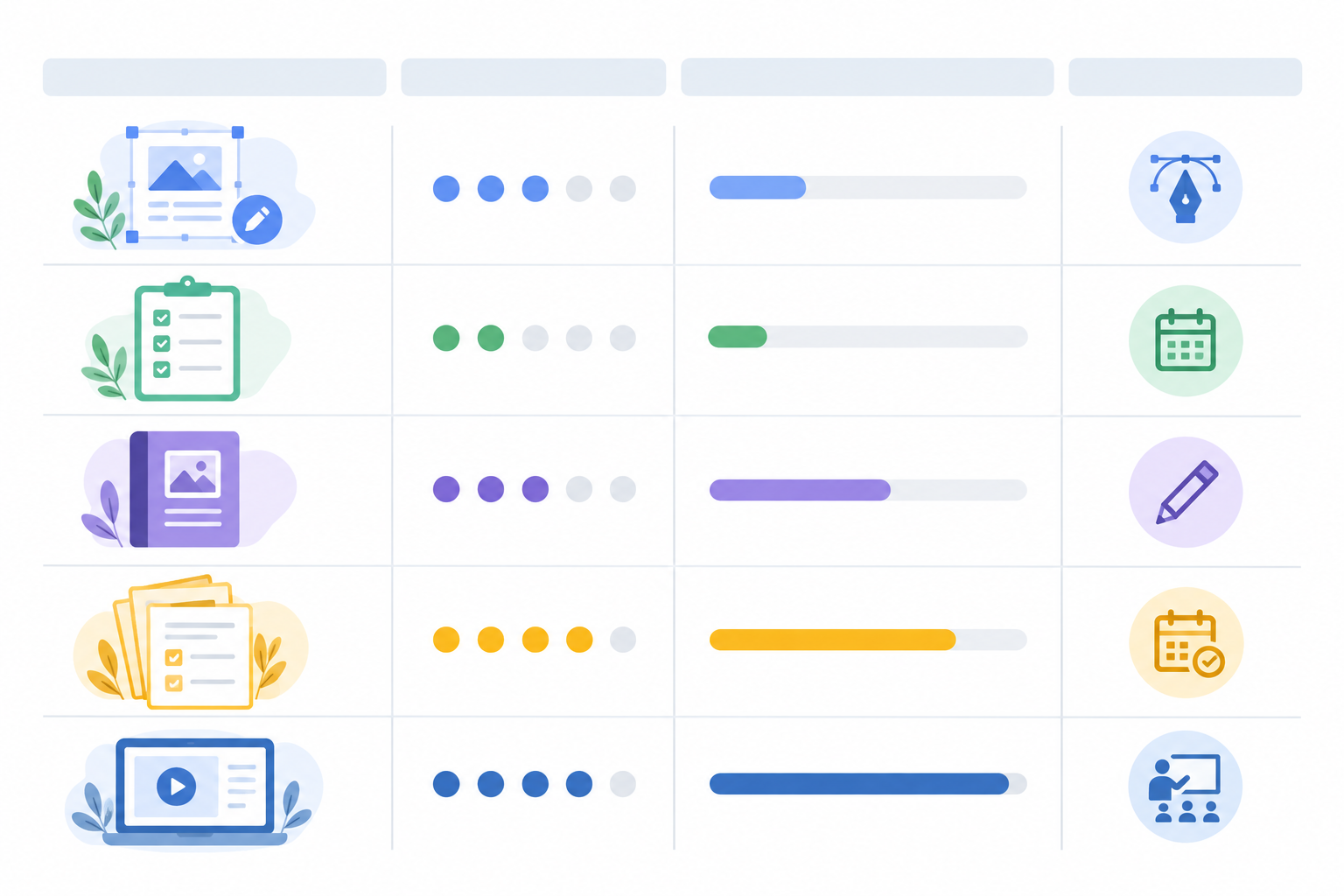
These ranges are starting hypotheses, not benchmarks we've measured across the market. To test yours, look at what similar products charge, then ask five people in your target audience what they'd expect to pay. Launch at one price, and only change it once you have real buyer behaviour to learn from.
What format should my first digital product take?
Choose the smallest format that fully solves one problem. For most people, that's a template, checklist or short guide. You can start testing prices from R49 to R299 and adjust based on what your audience and real buyers tell you.
Why templates and short guides work well as first digital products
They're fast to make, easy to deliver and low risk. If nobody wants it, you've lost a weekend, not a quarter. They're also light. Many South African buyers will open your file on a phone, sometimes on a patchy connection, so a compact PDF or a mobile-friendly template is often friendlier than a huge video file. State what software or device is needed so buyers aren't surprised.
Digital downloads aren't the only option
If your skill is better delivered live, you can add a booking system for 1:1 sessions, event ticketing for workshops, or a membership site for ongoing support later on. Many creators start with a download, learn what buyers struggle with, and then offer those richer formats as follow-ups.
Step 3: Create a Minimum Viable Digital Product
The goal of version one is done, not perfect.
- Write your promise in one sentence. 'After this, you'll be able to ___ in ___ time.' For example: 'After this, you'll be able to plan a wedding budget in one evening.' If you can't finish the sentence, the product isn't focused enough yet.
- Outline it on one page, then cut it by a third. First versions should be focused, not exhaustive. Everything you cut can become a bonus or version 2.
- Use free or low-cost tools. Canva works for layout, Google Docs and Sheets for guides and spreadsheets, Notion for templates, and your phone for screen recordings.
- Run a quality check. You want a clear title, consistent formatting, a quick-start page, real examples, and a test run by two or three friendly users. Ask them to try it without your help and tell you where they got stuck.
- Set a 'ship by' date. A template or checklist can take a weekend, a short guide one to two weeks, and a mini-course three to six weeks, depending on how much time you've got around your day job. A deadline stops the endless polishing.
- Protect your work. Put your name on every file, add a short terms-of-use note (for example, personal use only, no reselling), keep your source files, and use original images and fonts with the right licences. Canva and font licences vary, so check before you sell.
How long does it take to create a first digital product?
A simple template or checklist can take a weekend, a short ebook one to two weeks, and a mini-course three to six weeks. Set a deadline and launch a minimum version rather than waiting for it to feel perfect.
Step 4: Set Up Your First Sales Page and Start Selling
Your sales page doesn't need to be fancy, but it does need to answer a buyer's questions quickly. Include:
- A clear headline that states the result
- Who it's for (and an honest 'who this is not for')
- What's inside, including file type and how it's delivered
- A preview image or sample page
- The price in rand
- A clear buy button
Keep the buying journey short. Baymard Institute's cart abandonment research puts the average at around 70% across international online stores. That's a benchmark, not a prediction for your store, but it's a good reason to avoid surprise costs, forced account creation and clunky checkouts.
What to look for in an online store builder
You can sell digital downloads through a store builder, a link-in-bio page or a marketplace. Whichever you choose, check that it:
- Accepts the payment methods your buyers actually use, in rand
- Delivers the file automatically after payment
- Pays out to a South African bank account, and tells you clearly how often
- Shows all fees up front, so you can work out what you keep per sale
- Lets you grow into bookings, tickets or memberships later if you want to
Before you promote anything, run a small test order on your own phone, from payment through to the file arriving.
Example: setting this up on Shopstar
Disclosure: Shopstar is our platform, so this is an example from us rather than a neutral comparison. Features and pricing can change, so confirm the current details on the Shopstar site before you decide.
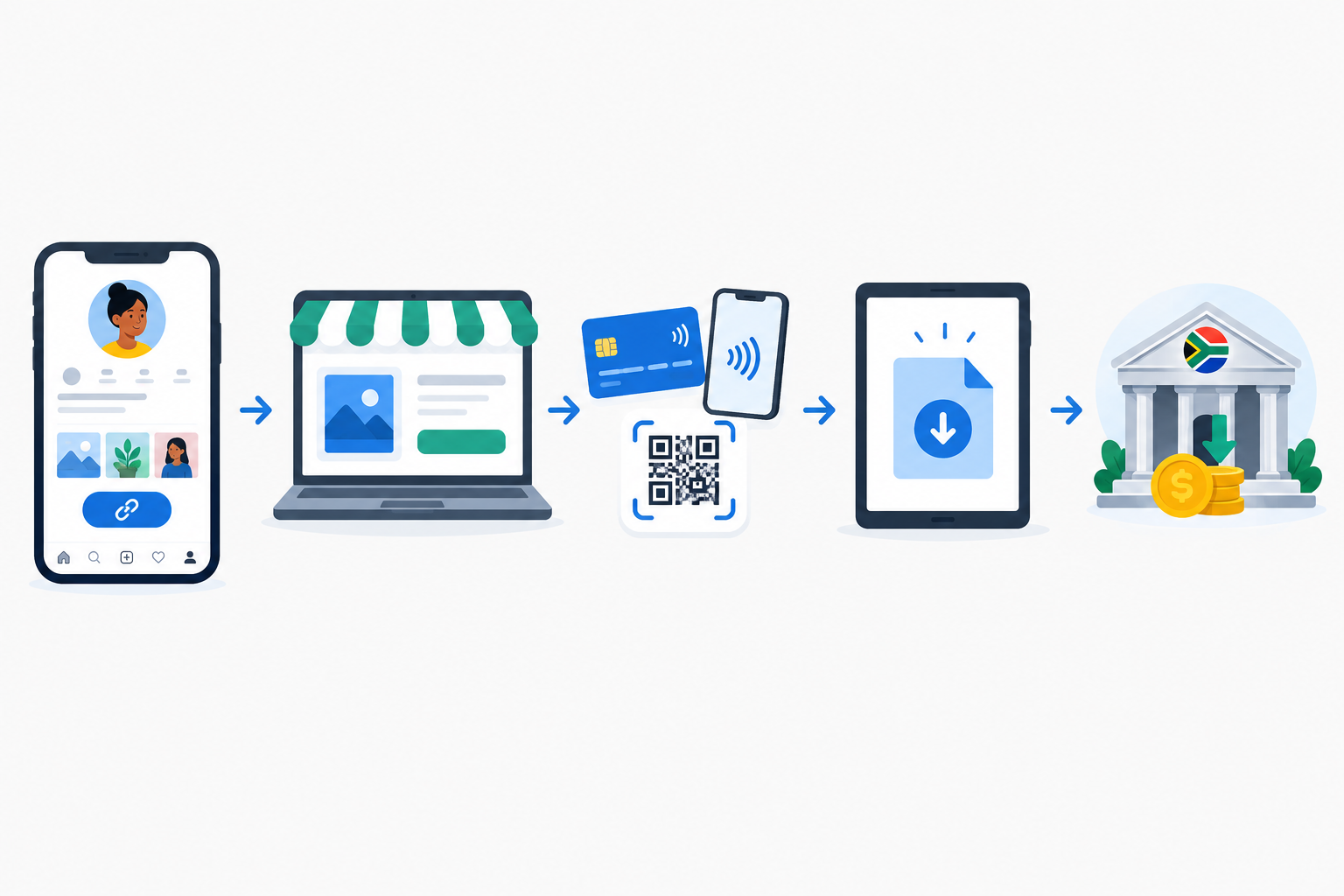
Shopstar is an online store builder and link-in-bio platform built for South African sellers. A typical digital-product setup looks like this:
- Claim a custom shopstar.page link (or connect your own domain)
- Upload your file and set your price in rand
- Share the link from your Instagram, TikTok or WhatsApp bio
- Buyers check out and receive the download, with payouts going to your South African bank account
The checkout supports options such as card, Apple Pay and Scan to Pay through Shopstar Go. Which options appear and how quickly payouts arrive can depend on your account, so check your dashboard for the current details.
What the fees look like on a R200 guide
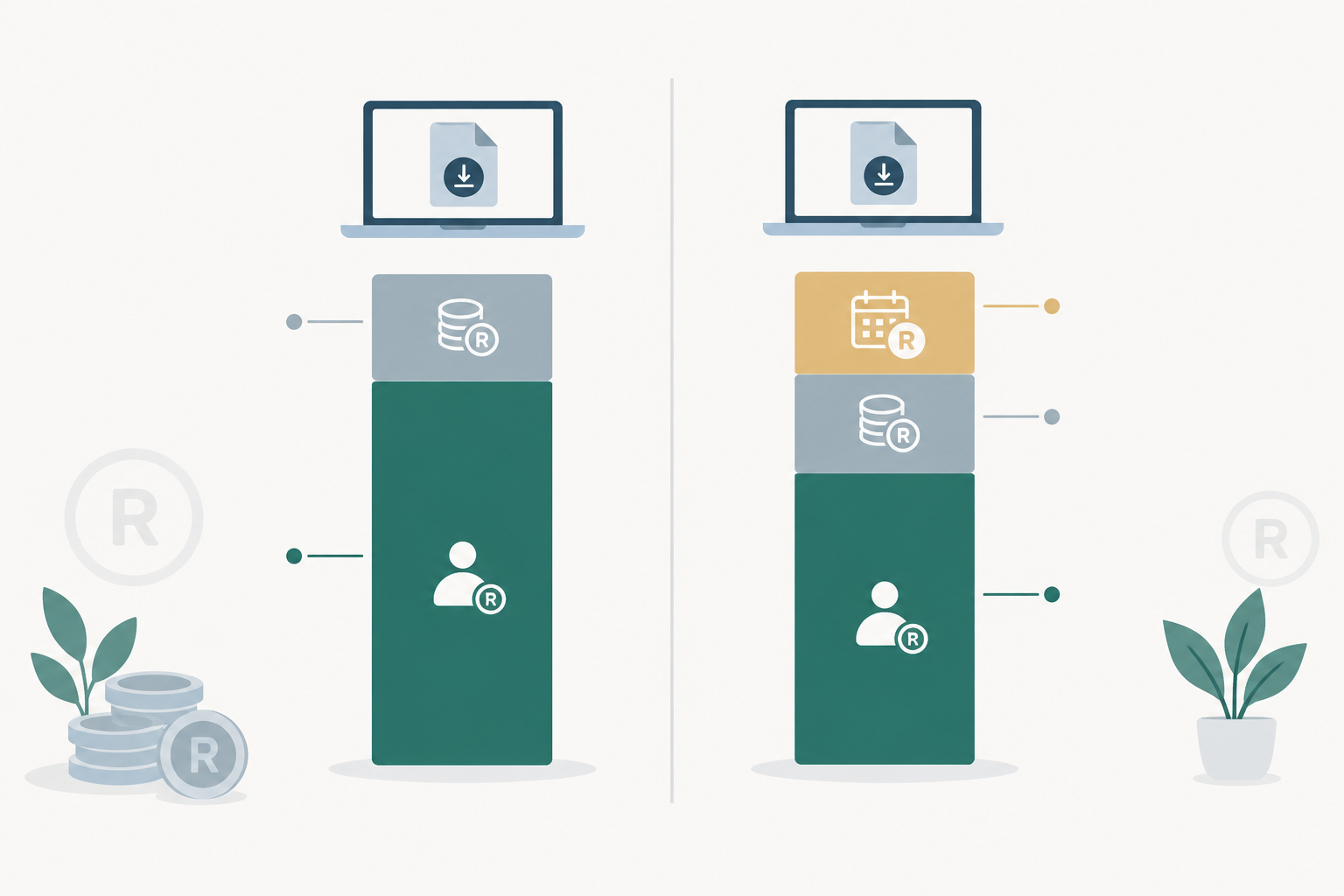
Shopstar has two plans. Here's how each works on a R200 guide:
- Start Free: no monthly fee, 6% all-in per sale (a 2.9% payment gateway fee plus a 3.1% Shopstar fee). That's R12 in fees, so you keep R188.
- Lower Fees: 2.9% per sale (R5.80 on the same R200) plus a monthly fee. See the current plan pricing on the Shopstar site for the monthly amount.
To compare them for yourself, take your expected sales per month, work out the percentage fee saved, and see whether it beats the monthly fee. At low volumes the free plan usually wins. As volume grows, the maths can shift.
Where to share your digital product
Start where your people already are: your Instagram or TikTok bio, your email list, a WhatsApp Channel or community, and local Facebook groups where self-promotion is allowed. Always check the group rules first.
Write sales copy that sells without hype
Lead with the problem, show the outcome, and be honest about who it isn't for. Something like 'This template is for freelancers earning under R500,000 a year; if you have a team and payroll, it's too simple' builds more trust than any shouty headline.
Tax, Consumer Rules and Customer Data in South Africa
This section shouldn't scare you. It's just a few good habits. The points below are a general summary based on the rules as we understand them at the time of writing, not tax or legal advice. Rules and thresholds change, so check the linked sources and speak to a registered tax practitioner or attorney about your own situation. 🧾
- SARS and income tax: Income from digital product sales is generally taxable, so keep records of your sales and expenses, including platform statements and payment fees. Whether something is deductible depends on your circumstances. See SARS for current guidance.
- VAT: The standard rate in South Africa is 15%. Registration becomes compulsory when your taxable turnover passes R1 million in any 12-month period, and it's voluntary from R50,000. If you register, your pricing needs to account for VAT. Confirm the current thresholds on the SARS VAT page.
- Consumer rules (CPA and ECTA): The Consumer Protection Act (CPA) and the Electronic Communications and Transactions Act (ECTA) shape how you describe products, state your terms and handle refunds online. ECTA expects clear seller details, a product description, the total price and your terms before purchase. Don't assume a blanket 'no refunds on digital downloads' line overrides consumer rights, because ECTA includes a cooling-off period for certain electronic transactions, with exceptions. Display a clear refund and cancellation policy, and get advice on how it applies to instant-access files. The National Consumer Commission is a good starting point.
- POPIA: If you collect buyer names and email addresses, only use them for what people agreed to, store them securely, and make it easy to opt out of marketing. Electronic marketing generally needs consent, with a limited exception for your existing customers, so keep proof of consent and make unsubscribing simple. The Information Regulator publishes guidance for small businesses.
One good habit: separate business and personal money where you can, save monthly sales reports, and publish your contact details and support info on your store.
Step 5: Gather Feedback and Improve Your Digital Product
Your first sales are the start of your research, not the finish line.
- Ask your first 10 buyers three questions: What did you hope this would do? What was most useful? What was missing?
- Watch behaviour as well as opinions. Which page gets views but no sales? Which questions keep popping up? Who asks for a refund, and why? Patterns matter more than one-off comments.
- Turn feedback into version 2. Add a bonus, fix confusing sections, update the title or preview image, and let early buyers know about the update.
- Collect testimonials, with permission, and add them to your product page.
- Decide what's next: raise the price, build a bundle, add a more advanced product, or offer a related service or workshop.
Your Digital Product Launch Checklist
Here's the whole guide on one page. Tick these off before you go live:
- I've named one specific problem and the people who have it
- Five people I know would plausibly pay for the solution
- My promise fits in one sentence
- I've chosen the smallest format that solves the problem
- Two or three test users have tried it without my help
- My sales page states who it's for, who it isn't for, what's inside and the price in rand
- My refund policy, contact details and terms are visible
- I've checked VAT, income tax and POPIA basics for my situation
- I've done a test purchase on my own phone
- I've set a date to review feedback after my first 10 sales
Your first product will teach you more than months of planning ever could. So ship the small version. 💛
Frequently Asked Questions About Selling Digital Products
How do I know if my skill is sellable?
Look for a specific problem that people already ask you about or complain about online, and that you can solve with a clear result. If you can describe who it's for and what they'll be able to do afterwards, and 5 people in your network would pay R100 to R200 for it, you have a strong starting point.
How can I test demand before I build anything?
Share a short description or a free sample page in a relevant WhatsApp group or Facebook community and see who asks for more. You can also offer a pre-order at a small price, or ask five likely buyers directly. Real replies and real payments tell you far more than likes.
What format should my first digital product take?
The smallest one that fully solves one problem. For most people that's a template, checklist or short guide, which you can start pricing from R49 to R299 and test from there. See the format table in Step 2.
Do I need to be an expert to sell a guide or course?
No, but you need real, tested experience and honest positioning. Be clear about your limits, especially in areas like legal, medical or financial advice.
How long does it take to create a first digital product?
A simple template or checklist can take a weekend, a short ebook one to two weeks, and a mini-course three to six weeks. Set a deadline and launch a minimum version.
Do I need a website to sell digital downloads in South Africa?
No. An online store builder with a link-in-bio page lets you list your product, take payment and deliver the file automatically, without building or maintaining a full website.
Do I have to pay tax on my digital product income?
Generally yes. Income from sales is taxable and must be declared to SARS, and VAT registration becomes compulsory once your taxable turnover passes R1 million in 12 months. Check current figures with SARS and speak to a tax practitioner if you're unsure.